Introductory Thoughts
In this review, I rely on my personal impressions and on the article written by Acampora.
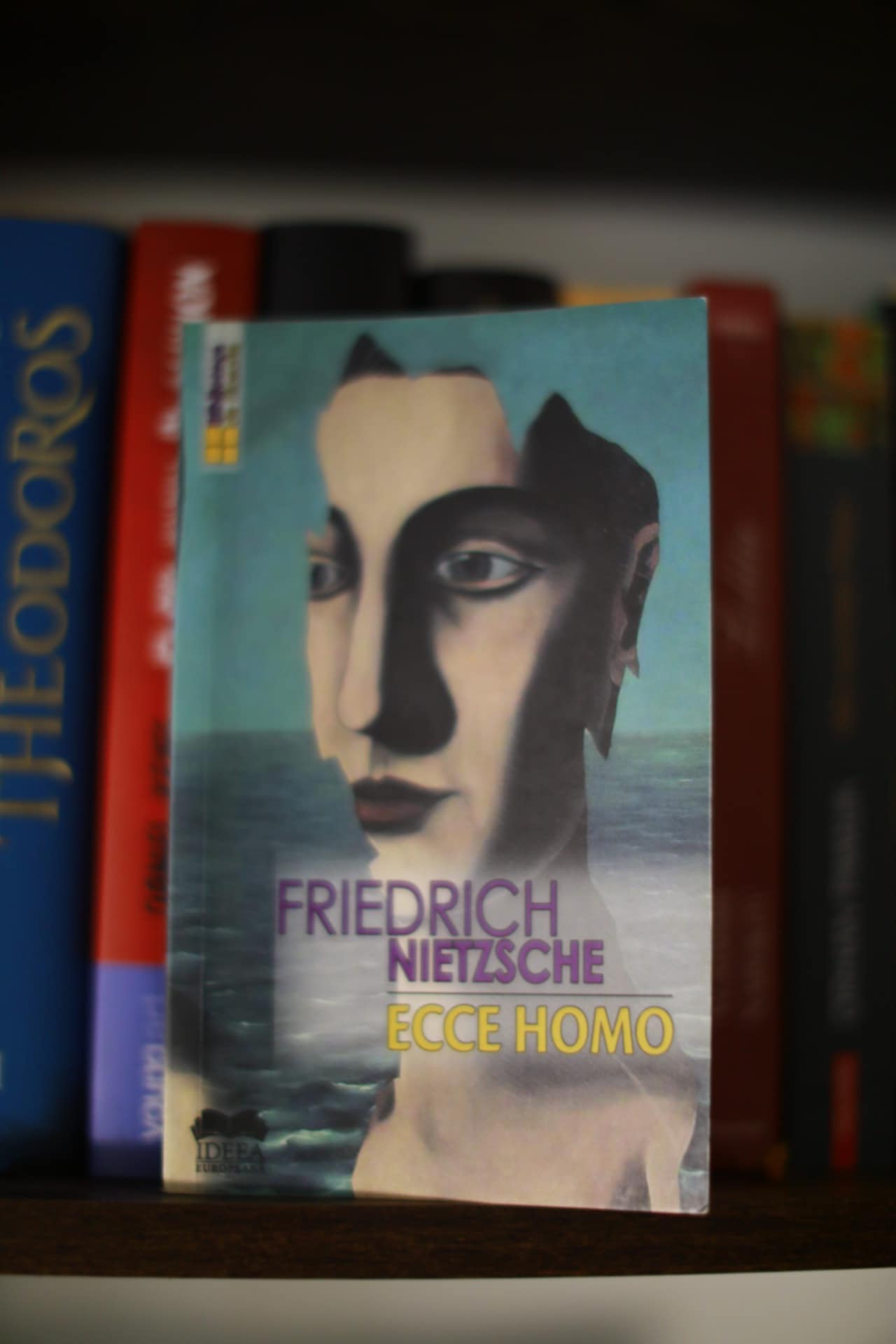
I’ve reached the final book. Ecce Homo was written during Nietzsche’s period of intense productivity between 1885 and his collapse on January 3, 1889. Work on the text began on his birthday, October 15, 1888, when he turned forty-four, and was completed three weeks later.
The title provocatively alludes to the moment when Pilate presents Christ (“Behold the man!”) and possibly to a memorial service for the dead, suggesting that Nietzsche is burying his past in order to be reborn.
The work reviews all of Nietzsche’s major publications, framed by introductory chapters on his wisdom, cleverness, and writing style, and a final chapter on his significance as destiny.
Although completed, Ecce Homo was not published during Nietzsche’s lifetime and only appeared in 1908, in a version that had been edited and shortened.
A Philosophical Prophet
Few words put to paper can have such a shattering impact on the reader, whether because they are arranged in a stunning way or because they convey a staggering message. Or perhaps both. “I know my fate. Someday, my name will be associated with something monstrous, with a crisis unlike any that has ever existed on earth, with the deepest collision of consciences, with a verdict invoked against everything that has been believed, promoted, or sanctified until now. I am not a man, I am dynamite.” (p. 192) Will that day ever come?
I cannot help but notice that he sometimes presents himself, perhaps unintentionally, as a messianic figure: “Thus, like figs, these teachings fall upon you, my friends: now drink their juice and eat their sweet flesh!” (p. 37) This resembles quite closely what is written in the Bible, specifically in the Gospel of John 6:54: “Whoever eats my flesh and drinks my blood has eternal life.”
Pindaric Expression
The book, subtitled How One Becomes What One Is, appears as a form of Nietzsche’s self-presentation. Yet several questions arise: Why does Nietzsche do this? What do we truly learn from the book? Is it more of a behind-the-scenes look at his thought and real motivations? How complete can it be as an autobiography, considering that it focuses mainly on his writings and was composed just before Nietzsche’s descent into madness? This work must be understood in relation to Nietzsche’s controversial and paradoxical ideas about autonomy, destiny, and freedom. The self-image Nietzsche constructs here shows that he anticipated a realizable form of human freedom, though one more limited than what is sometimes suggested by critical literature about him.
The Pindaric expression “become what you are” might suggest a Bildungsroman-like narrative of personal development, but Nietzsche complicates it. How can one become what one already is? Is it about realizing hidden potential, or transforming chance into necessity? Nietzsche describes himself both as “fated” and as “destiny,” shaped by inheritance and atavistic forces, yet capable of unifying opposing tendencies within himself. For him, “becoming what you are” does not mean realizing a given essence, but transforming these inherited tensions into a coherent and life-creating necessity.
Nietzsche as the First Psychologist
Nietzsche views humans as composed of competing drives, affects, and thoughts, structured by orders of rank. These hierarchies determine different types of people: the master, the slave, the priest, or even the overman, depending on how the drives are organized and which dominate. For Nietzsche, there is no fixed self behind this ordering; the self is the arrangement of drives, a political structure in which some command and others obey.
What we call will or freedom is not a metaphysical power, but the felt experience of this organization, where drives both command and obey. Although these drives are inherited and historically shaped, their hierarchy is not fixed, leaving room for reordering. Thus, “becoming what you are” means transforming chance into necessity by shaping and stabilizing these competing forces into a coherent structure of rule.
The Art of Self-Preservation
In this work, Nietzsche answers the question of “how to become what you are” through what he calls the art of self-preservation or ideal egoism. Unlike Wagner, whom he described as devoted to loyalty and altruism, Nietzsche presents his own development as marked by instinct for self-preservation and careful attention to small things: diet, climate, health, the rhythms of life. For him, egoism is not exploitation or isolation but an accumulation of forces that, once mature, overflow and enrich others.
This perspective connects to the idea of amor fati (the love of fate) which implies not merely accepting but affirming and loving what is necessary. Nietzsche attacks the morality of altruism, which he sees as decadent and life-denying, and proposes egoism as a guiding thought that enables the organization of forces and the development of creativity. Thus, self-preservation becomes a way to nourish the power to create, to project ideals, and to surpass limits — making egoism a condition for freedom and the fullness of spirit.
Four Principles of War
Nietzsche’s practice of war expresses how he organizes his drives and defines himself as a thinker. To become what one is does not mean merely realizing a preexisting essence or creating an entirely new self; it happens through confrontations and resistances that structure the hierarchy of drives.
Nietzsche describes four principles of his warfare: attack ideas, not people; choose strong and significant opponents; avoid fights driven by resentment; and wage individual, not mass, battles. I should add that it must be clearly understood that Nietzsche did not fight against Christian people, but rather against Judeo-Christian doctrine. “Thus I attacked David Strauss, more precisely, his success (…). Thus I attacked Wagner, more precisely, his falseness.” (p. 58) Indeed, he mentions that he had faithful Christian friends, and there was mutual respect between them. If you imagine him in a hall full of Christians starting a brawl, you are mistaken.
Through these confrontations, he tests and develops his forces, creating new ideas through overcoming rather than mere destruction. Still, destruction and negation remain necessary conditions for creative affirmation. Nietzsche defines himself as an agonistic nature, nourished by opposition and diversity, capable of transforming tensions into productive order. In this book, he insists that he did not become anything other than what he already was; he cultivated and protected his nature through egoism, self-defense, and love of his destiny.
Become Who You Are
For Nietzsche, “becoming what you are” does not imply a fixed plan or predetermined essence, but results from the way inner drives and forces are organized through confrontations, relationships, and life conditions. He emphasizes the importance of self-preservation and cultivation: avoiding what weakens, and seeking experiences, friendships, environments, and practices that give shape and coherence to this multiplicity of impulses. Thus, freedom does not mean absolute autonomy, but the capacity to become a necessity: to transform inner diversity into expressive and powerful unity. Nietzsche rejects both rigid fatalism and the idea of unlimited self-construction, proposing instead a fluid, agonistic, and relational vision of self-development.
Will Nietzsche’s work be a voice that echoes across the millennia?
Brian Domino and Amor Fati in Nietzsche`s Ecce Homo

Ecce Homo was meant as a preparation for Nietzsche’s coming “revaluation of all values.” In it, he tries to explain who he is and why humanity should take him seriously. Yet this goal is complicated by Nietzsche’s own sense of “decadence,” a spiritual illness that clouds judgment about what is healthy or corrupt. Fearing he might spread his own sickness, Nietzsche insists he is not a prophet to be followed. Instead, he separates the teaching from the teacher, urging readers to judge his ideas, especially amor fati, on their own terms.
Domino shows that amor fati (the love of one’s fate) is not the same as eternal recurrence. The former is a personal, psychological stance; the latter, a cosmic theory. For Nietzsche, to love one’s fate means affirming what is necessary and rejecting idealistic fantasies of a “better life.” If you want to know more about the notion of eternal reccurence, please read my review on Thus Spoke Zarathustra.
In Ecce Homo, Nietzsche deliberately portrays his failure to live up to amor fati. This self-exposure forces readers to examine the idea itself rather than idolize him. Ultimately, Ecce Homo invites courageous, experimental readers, not blind followers, to test Nietzsche’s ideas as tools for self-overcoming.
What do you think? Does the notion of amor fati make Nietzsche a Stoic, despite his aversion towards Stoicism, or is there something more nuanced to his philosophical stance?
1 thought on “How to Become Who You Are: Ecce Homo”