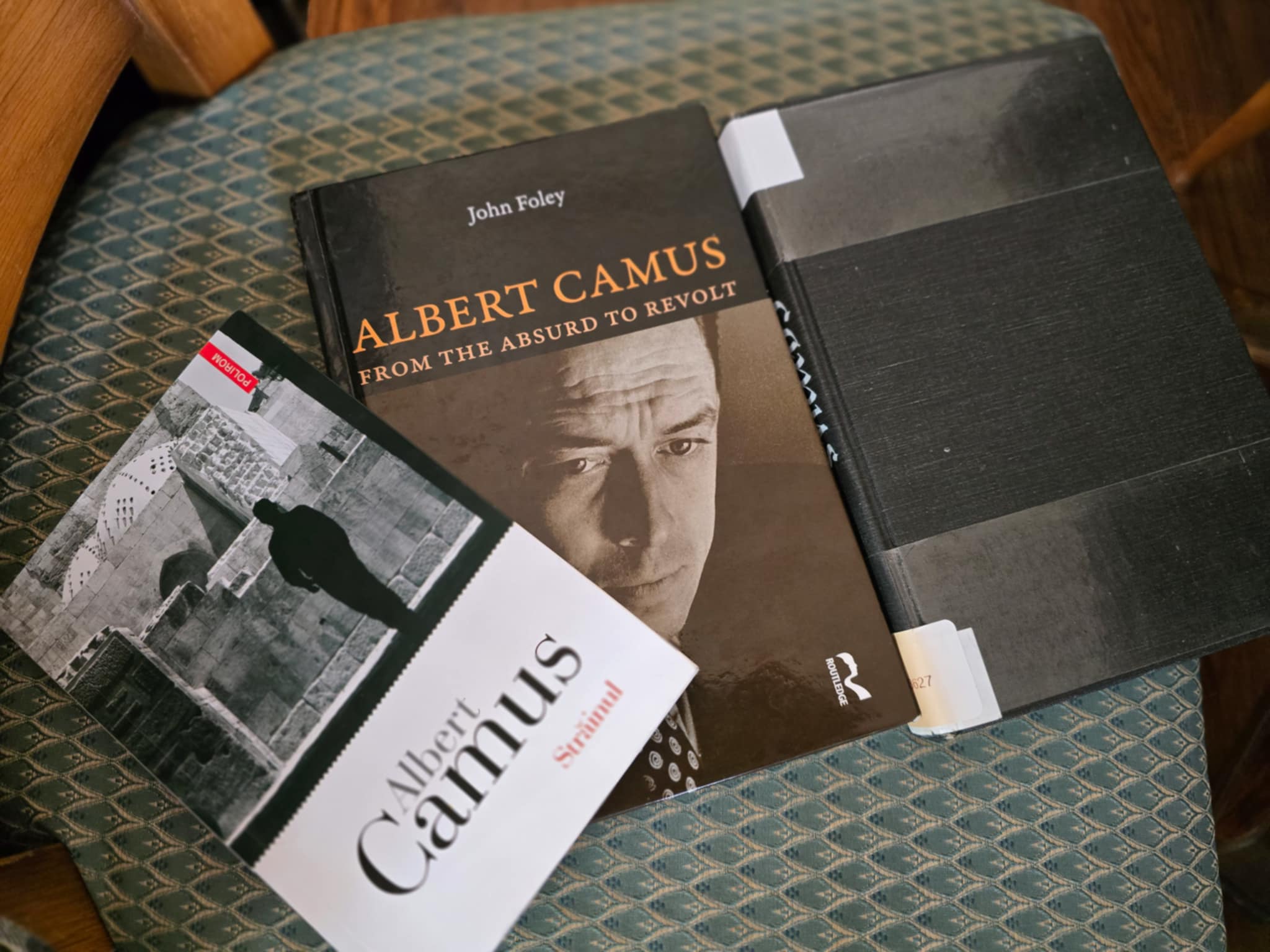
“We are all condemned to death” (p.141).
The Philosophy of the Absurd
Although Albert Camus is often associated with existentialism, he consistently rejected that label and sought to distinguish his ideas from those of existentialist philosophers, particularly Sartre. Camus’s main philosophical concern was whether human beings could create their own values without relying on religion or rationalist systems. While existentialists like Kierkegaard and Sartre sought meaning through faith or freedom, Camus criticized them for, instead of accepting that the absurd reveals the limits and meaninglessness of life, “deifying” it: giving it meaning and turning it into something they could believe in. For Camus, this was a form of self-deception.
Camus argued that although life is absurd and meaningless, this realization should not lead to despair or to the invention of false consolations. On the contrary, it should be the starting point for understanding how to live authentically. His thought is built around two key concepts: the absurd and revolt. The absurd describes the confrontation between humanity’s desire for meaning and the silence of the universe, while revolt is the active and moral response to that absurdity. Camus believed the two ideas must remain linked: without revolt, the absurd turns into nihilism; without awareness of the absurd, revolt risks becoming tyranny.
For him, even in a godless world, human beings can act with generosity, create their own values, and show solidarity toward one another. His entire body of work explores how a person can live and act morally in a world that offers no ultimate meaning.
Now let’s turn to the story itself in The Stranger:
The book opens with our protagonist, Meursault, receiving news of his mother’s death through a telegram: “Mother died today. Or maybe yesterday” (p.7). He attends her funeral without displaying any grief, which shocks those around him. Soon after, he resumes his ordinary life, entering a casual relationship with Marie, a former coworker, and befriending a neighbor whose violent behavior toward his mistress leads to trouble.
One day, during an outing at the beach, Meursault, dazed by the blinding sun and suffocating heat, impulsively shoots an Arab man (his neighbor’s enemy) five times. He is arrested and put on trial, but the proceedings focus less on the murder itself and more on his lack of emotion, especially his detached behavior at his mother’s funeral. “They talked a lot about me, much more than about the crime I had committed” (p.118).
The court and society interpret this indifference as proof of moral corruption. The judge calls him “Mr. Antichrist” (p.86). Another telling passage states: “His disgust for the crime itself almost faded compared to the disgust my indifference provoked in him. He considered that a man who kills his mother morally is cut off from the human community” (p.122–123).
In the end, Meursault is sentenced to death. In the final pages, he comes to accept the absurdity of existence, the idea that life has no inherent meaning and that death is the only certainty. Finding peace in the realization that the universe is indifferent to human life, he faces his execution with calm and clarity.
The Absurd Hero
Through Meursault’s story, Camus illustrates his philosophy of the absurd: the conflict between humanity’s need for meaning and the silence of a meaningless universe. Here we can also trace the influence of Schopenhauer.
Meursault is portrayed as the absurd hero par excellence, whose fate must be understood alongside Camus’s philosophical essay, The Myth of Sisyphus. He is a stranger to our usual feelings, refusing to interpret his life or attribute to it any meaning beyond immediate sensory experience.
The killing of the Arab disrupts the natural order of Meursault’s world. The act itself is depicted as a quasi-instinctive, physiological response to oppressive heat and tension, not a deliberate, purposeful crime. However, the novel suggests that his true guilt lies in his lack of lucidity, which allows him to become an accessory to the destruction of a human life by passively yielding to nature’s forces.
Meursault’s execution is not determined by the murder of the nameless Arab but by his social nonconformity. This is embodied in his refusal to lie, specifically, his refusal “to say more than is true, and in the case of the human heart, to say more than one feels.” Society insists on assigning evil motives to him in order to reaffirm its own moral order and coherent values.
Because Meursault lives within the context of the absurd, he has no objective criteria for determining moral values, which leads him to agree to requests such as writing a deceitful letter for his neighbor Raymond, reasoning that he had “no reason not to please him” (p.41).
The Rebel Hero
In prison, Meursault achieves reflective self-awareness, moving from a rebel de facto to a rebel de jure. At first, he lives and behaves as a rebel, rejecting social conventions, lies, and moral norms, without consciously choosing or declaring this stance. But by the end, he becomes fully aware of it and embraces it. His final outburst against the priest is a passionate reaffirmation that his values were of this world and that he had been right to live a life devoted to the pleasures of the physical present.
Existential Anxiety?
I must add that Meursault evades the existential anxiety described by existentialist philosophers, that is, the conscious confrontation with one’s own freedom and responsibility for existence. When Raymond asks him if he wants to be his friend, Meursault replies, “it’s all the same to me”; likewise, when Marie asks if he wants to marry her, he says it doesn’t matter, that “yes” is as good as “no.” In both cases, he projects no meaning or value onto his choices. He does not ask himself what they imply or what they mean for him.
While for existentialists such as Sartre or Kierkegaard absolute freedom gives rise to anguish, for Meursault it does not even seem to exist as a problem. He feels no need to choose in the deeper sense of the word, but reacts to situations purely factually, without moral or emotional reflection. Meursault does not experience the anguish of freedom but rather an existential neutrality: he accepts the world as it is, without trying to interpret it or give it meaning. He is the man who does not seek meaning, does not invent it, and is not troubled by its absence.
The novel can be seen as an exploration of the path toward self-conscious affirmation: through the rejection of the weight of social expectations and routine.
Meursault’s conscious rebellion and embrace of the physical, immediate world parallels Nietzsche’s idea of the Übermensch, who creates values and lives beyond traditional moralities. If you are interested in Nietzsche and his notion of the overman, please read my review on Thus Spoke Zarathustra.
Did you enjoy it? What are your thoughts?


2 thoughts on “Camus`s The Stranger: A Strange Hero and the Absurdity of Life”