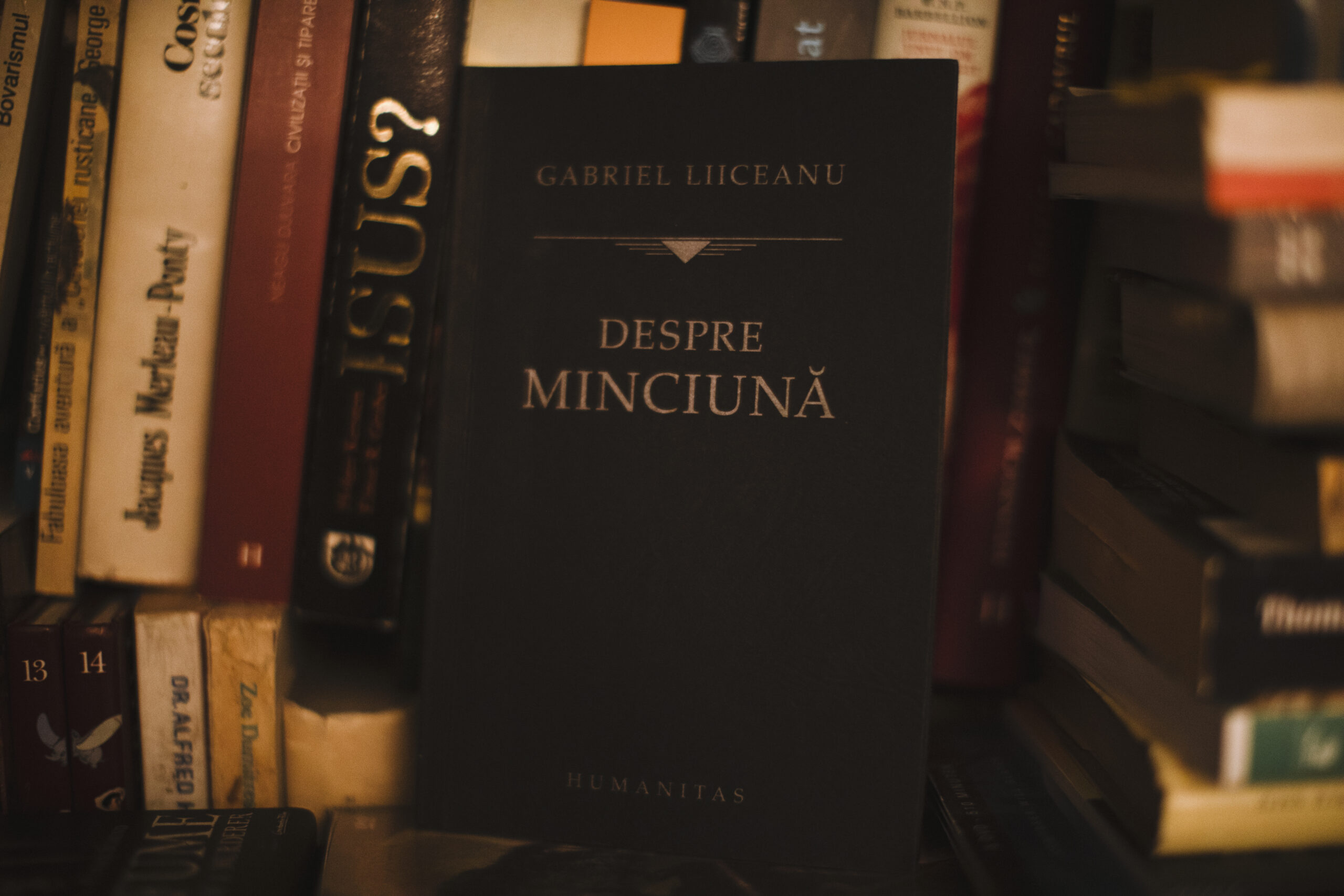
The Problem of Lying
For a long time I have been troubled by the problem of lying, not only as an everyday act, but as a moral and cultural phenomenon. Gabriel Liiceanu’s book On Lying caught my attention precisely because it addresses this universal theme, with examples from philosophy, literature, and history. The present review is an attempt to highlight the essential ideas and place them in context.
Lying (or intentional falsehood) occurs exclusively in the realm of the speaking animal, that is, the human being. And since humans are both free and fallen, they can use language in two ways: either along the path of truth or along the path of lies. This idea reminds me of Descartes and his Meditations on First Philosophy, specifically the Fourth Meditation, where the French philosopher speaks about truth and falsehood.
Descartes mentions that humans can commit errors because they are situated somewhere between God (or the supreme being) and nothingness (or non-being). While humans partially participate in divinity (or perfection), they also partially participate in non-being (or finitude and error). Thus, we can trace a comparative line between the Cartesian human, who exists on the axis between <supreme being and non-being>, and the language-using human, who is, theologically speaking, both free and fallen. To quote Liiceanu: “lying can in fact only be understood as a negative moment of freedom.” Language not only says what is, but also what is not.
Odysseus and Achilles
According to Sophocles’ Philoctetes, Liiceanu concludes that lying can be the means by which one cheats in order to win. This can be described as Odysseus’s equation, and the morality it founds, as modern morality or morality of the second order. It stands in opposition to classical morality, or morality of the first order, which underpins Achilles’s equation. Achilles’s equation can be described by the aim of victory reached through deed, namely strength and courage. “It is preferable to lose than to win by dishonest means.” We thus have before us two types of character, corresponding to two types of morality: one immoral and the other, honest.
According to one of Plato’s dialogues, Hippias Minor, “the most knowledgeable is the one who can lie best and, implicitly, he is the most competent in the sphere of evil.” Thus, the ignorant man is inferior to the liar, or in Platonic language: “those who do wrong unintentionally are inferior to those who do it knowingly.” From this it follows that the one who deceives deliberately is better than the one who does so unintentionally, “just as the archer who misses the target on purpose is better than the one who misses it involuntarily.” What kind of world order is it where the “good” ones are those who competently and deliberately commit evil?
Liiceanu concludes that “both plays represent the loss of the age of innocence at the level of human coexistence, the awareness that society, at a certain age, has lost its moral virginity.”
Machiavelli and Political Morality
The book continues with Machiavelli, noting that the modern world discovers the morality of the second order as political morality, namely that “in the fallen world of man, in order to stem a greater evil and to achieve (common) good, one must come into contact with evil.”
An interesting historical example: Churchill, in order to prevent the Germans from realizing he had cracked their most secret military code, allowed an entire city to be bombed (without warning even his relatives or friends). In the name of the morality of the second order, other such acts have been committed in history: the dropping of the bomb on Hiroshima and the American invasion of Iraq in 2004. Machiavellian speaking, one must not be evil, but must resort to evil “when good must be saved, defended, or consolidated.”
The Backbone of Evil in Comunist Romania
The final part of the book discusses lying and the “best country in the world,” Romania, the country of filetists and the uncultured (according to the latest research I conducted). In Romania, lying has been “the backbone of Evil”; it has served not the good, but pure evil. Under communism, lying was a pseudo-lie, that is, a false lie, because “the one who is lied to is not really deceived, but by pretending to believe, in turn, he too lies.”
Lying was so pervasive that it saturated all levels of society. There was no longer any place where a piece of truth could be spoken. One thus lived in a society “infinite in mirrors,” where everyone lies to everyone else in all directions; the liar lies to the lied-to, who in turn lies to the liar, and the liar lies once more by pretending not to know that the one lied to knows he is being lied to. Here we are faced with a more whimsical lie than all others: the collective lie.
Observations and Remarks
Since Plato was mentioned, why was nothing said about the noble lie in the Republic, that is, the philosopher-king’s suggestion that he may lie to the common man for the harmony and good of the city? Or is this, from Liiceanu’s point of view, precisely the morality of the second order as political morality?
What fundamental questions can we draw from this text? How necessary is lying for survival in a world of conflicts? Is it a form of evil or an inevitable instrument of good? Gabriel Liiceanu’s book opens these questions through a dialogue with the great thinkers of the past and with the realities of recent history. I would add here two more thinkers who had their own approach to lying, namely Kant and Schopenhauer.
Immanuel Kant and Moral Duty
A remarkable thing about Kant is that his approach is more Christian than the Christians themselves — if we are to take him at his word. Do not lie, under any circumstances sounds not only excessively demanding, but also disturbing. Recall the opening scene of Tarantino’s Inglorious Basterds, where a French farmer, in Nazi-occupied France in 1941, hides a Jewish family beneath the floor of his house. Colonel Hans Landa, the character we love to hate (or even hate to love), arrives at the isolated farm to inspect.
Now, imagine if the farmer, with complete nonchalance, when asked if he is hiding Jews in his house, had answered truthfully. Of course, the scene unfolds tensely, and the Frenchman ultimately gives in under Landa’s pressure, but this happens against his will. Why did he not say from the very beginning that he was hiding Jews? The answer is: from a moral sentiment, precisely the one Kant exalts and believes exists a priori in man. Yet, in Kant’s ethical project, the moral duty here would be not to lie, regardless of consequences, because his theory is not consequentialist but deontological.
Arthur Schopenhauer`s Response to Kant
Schopenhauer, very likely in response to Kant, mentions an interesting example in Book IV, Chapter 62 of The World as Will and Representation: “he who refuses to show the lost traveler the right road does not wrong him; but he who directs him to the wrong road does.” From this we may understand that he proposes a middle way to Kant’s idea. That is, the French farmer, asked by Landa if he was hiding Jews, should have adopted a strategy of avoidance without direct lying.
Of course, from our point of view, especially in the film’s situation, Schopenhauer’s approach is also bad, and less beneficial than utilitarianism, which, in order to maximize good and minimize suffering, would justify a lie without hesitation. Schopenhauer’s idea, however, is intuitively correct: refraining from telling the truth is not the same as lying, but merely a form of withholding information.
What do you say about lying? Is it justifiable when an evil can create a good?
If you are interested in reading more about evil and good, you can always check my review on Nietzsche`s book, Genealogy of Morals.
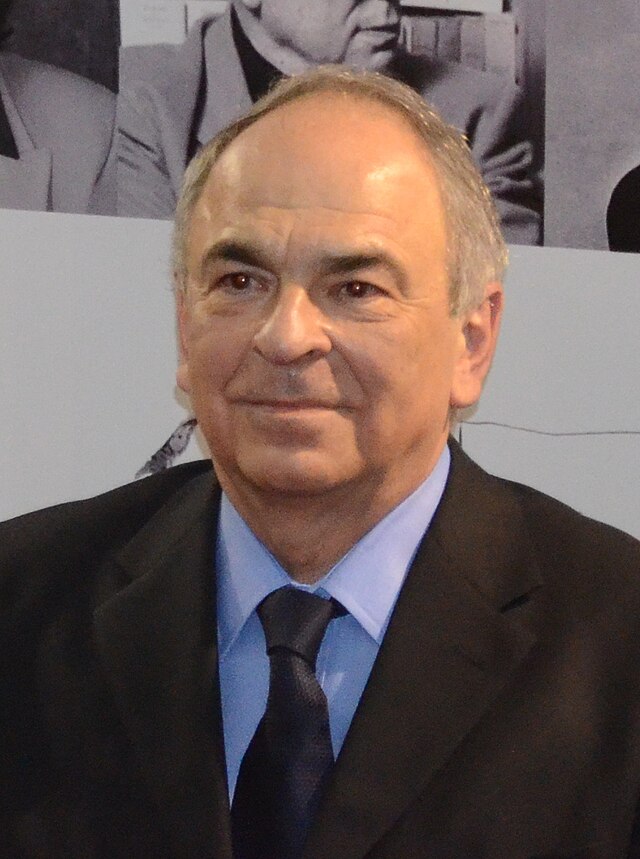
In this photo you can see Gabriel Liiceanu, a contemporary philosopher and university teacher in Bucharest, Romania. He is one of the last figures representing the remains of old school Romanian philosophy and intellect. He, alongside Andrei Pleşu and others, is famously known as being one of the disciples of Constantin Noica, one of the greatest intellectual figures in Romanian`s cultural treasury.

1 thought on “On lying, by Gabriel Liiceanu: Can Evil Justify Good?”