The Influence of Schopenhauer
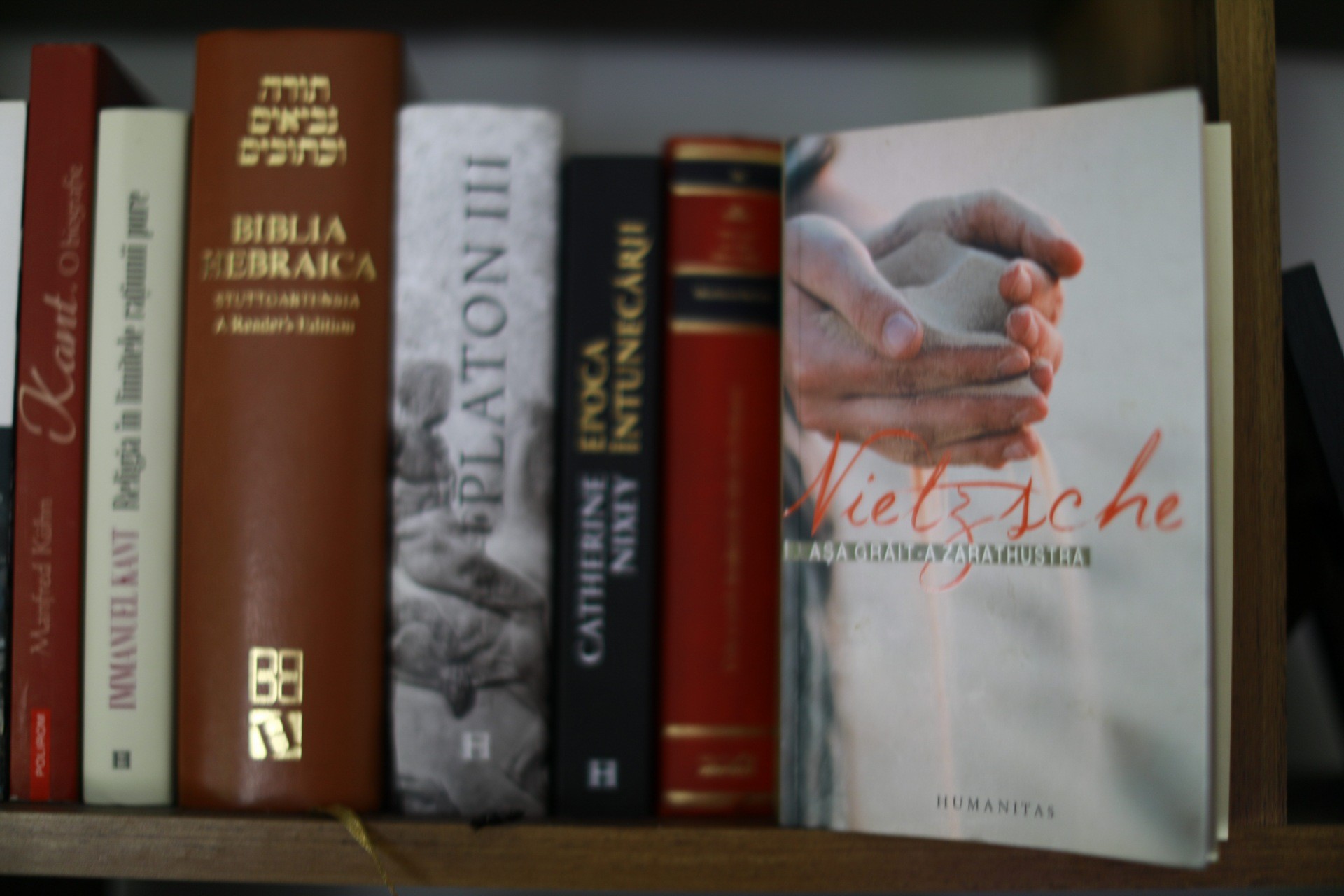
Before Nietzsche, another philosopher announced the death of God. This was Phillip Mainländer, with his lesser known work, The Philosophy of Redemption, although for him the death was actually a suicide. Both he and Nietzsche were strongly inspired by Schopenhauer, borrowing the concept of “will” and taking it in different directions: for Nietzsche it becomes the will to power, for Mainländer, the will to die. For the latter, the universe represents the rotting corpse of God. With every moment, everything that exists marches toward death.
Analysis of the Book
Thuis is a brief review with the help of David B. Allison and Laurence Lampert. I would also like to point out that I am only listing the books by Nietzsche that I have in my library in chronological order, and not his entire philosophical work. Let’s begin!
If you are wondering how Zarathustra acquires wisdom just by climbing mountains and living in nature, without the empirical aspect of living among people day to day, well, I think we can find a suitable answer in Professor Iosif Brucăr, who wrote about Spinoza’s life and philosophy. He said that the West gives birth to geniuses, and the East to prophets. Truth is discovered by the former, and therefore dynamic, and revealed to the latter, and therefore static. We can therefore say that the heavens open up to Zarathustra not to receive Truth (in which Nietzsche does not believe), but wisdom.
Between 1883 and 1885, Nietzsche wrote Thus Spoke Zarathustra in several bursts of extreme activity. Throughout his life, he referred to this book as his most important work. Some essential themes in this work are: the dynamics of human will, the death of God, criticism of traditional Christian morality, the will to power, eternal recurrence, and the Übermensch. Despite these, there remains a hidden layer to the book in which Nietzsche reflexively addresses his own most personal, philosophical, and emotional concerns. Among these problems were questions about the validity and practicality of his own philosophical task, his doubts about his own ability to communicate his ideas effectively.
Who was Zarathustra?
The name Zarathustra was chosen strategically, as he was (Zoroaster, through the Greek derivation) the first historical thinker to pronounce the dualistic teaching of good and evil as separate principles of the world, called Ahura Mazda and Ahriman, forces of light and darkness. Thus, the creator of morality is ironically brought down by Nietzsche’s own Zarathustra. Zarathustra more accurately embodies a post-Platonic, post-Christian, postmodern thinker capable of challenging conventional understandings of good and evil. The book itself served as a surrogate family for Nietzsche, who affectionately referred to Zarathustra as his “son.”
The Heaviest Burden
The basic concept of this magnificent work is eternal recurrence, described by Nietzsche as “the highest formula of affirmation.” This idea, which first came to him in Sils Maria in August 1881, appeared publicly for the first time in The Gay Science, in the form of “the heaviest burden.” It functions as a selective principle that either transforms or crushes individuals, depending on their attitude toward life. It cultivates those who love the earth, encouraging an “affirmation of self and world,” in contrast to traditional religions based on “revenge against earthly life.”
The Will in Nietzsche`s Thought
Zarathustra’s initial attempt to teach the masses about the Übermensch fails, prompting him to seek out individual disciples. He introduces the three metamorphoses of the spirit (camel, lion, child) as a path to creative freedom. Crucially, he names for the first time the “will to power” as the fundamental essence of all living beings and, indeed, of existence itself, underpinning all actions and valuations. It is not just a desire for domination, but the intrinsic impulse of life to constantly surpass, grow, and create beyond itself, manifesting itself even in the will of a servant to become a master.
A more faithful translation of Nietzsche’s thought would be “the will towards power,” because it attributes a much more dynamic dimension to Schopenhauer’s desire to live; it means wanting to surpass yourself, to fight against resistance; to be is to become more. Zarathustra’s journey in the book is, for the most part, an odyssey of understanding and accepting this concept, which serves as the sole source of all values, including good and evil, and which ultimately ties in with the highest affirmation of life: the idea of eternal recurrence.
Against the Notion of Morality
Zarathustra returns to his disciples with a new and wild wisdom, criticizing modern morality, especially the prophets of equality, as being rooted in resentment of suffering. Through song and introspection, he achieves a profound self-transcendence and reinterprets the philosophers’ “will to truth” as a disguised “will to power,” shaped by revenge against the past.
There is a unique literary form of Zarathustra, which includes characters, setting, and plot, presenting ideas through images rather than conventional arguments. The work uses an aphoristic style, requiring active interpretation and shared discovery on the part of the reader. Although Nietzsche planned additional parts for Zarathustra, he only completed four: parts 1–3 form a complete whole, and part 4 is a fragment. Nietzsche’s later published books were polemical writings, leaving Zarathustra as his only complete philosophical masterpiece.
If you are interested in Nietzsche diving more profoundly into the idea of morality (and of course, against it), you can always read my review on Genealogy of Morals.
Christianity as a Dragon With Golden Scales
To keep my word, I must therefore continue with what I set out to do regarding Nietzsche’s philosophical approach, where his struggle with the dragon with golden scales on which is written YOU SHALL! is born and developed. There are many approaches here, but the most obvious is the death of God. The death of God signifies the disappearance of faith in a transcendent authority, from another world, which once dictated human values and morals.
This statement removes the foundation for traditional “hopes beyond the world” and the concept that “sin against God was the greatest sin.” With the collapse of this divine foundation, humanity is called upon to radically reorient itself: to bind its loyalty to the earth and affirm life as it is, rather than seeking escape or perfection in an afterlife. This void opens the way for humanity to become the creator of its own new values and meanings, ultimately pursuing the ideal of the Übermensch, driven by the will to power.
The notion of the Übermensch

The Übermensch in Nietzsche’s philosophy is presented as the meaning of the earth. This concept is introduced as the counterideal necessary to replace the Christian ascetic ideal following the death of God, an ideal that previously encouraged humanity to reject earthly life in favor of supraterrestrial hopes.
The Übermensch is not a literal “superman” or a biological upgrade. Nietzsche explicitly states that the notion is not to be conceived along Darwinian lines or as representing a transcendental ideal. It is not “super” or “above” (über) in the sense of an infinite future beyond the reach of mortals. Instead, the term plays on the connotations of über (across, over, beyond). It signifies a process of profound self-overcoming where the present self must perish in order for the new self to strive into existence. Zarathustra declares he loves the person who “wants to create beyond himself, and thus perishes”.
The concept is intrinsically tied to the doctrine of eternal reccurence, which provides the form of universality necessary for an individual act of willing (self-legislation). The Übermensch is the vision that emerges out of the riddle of eternal reccurence and represents the human type capable of enduring and affirming this abysmal thought. This figure embodies the creative and innocent will to power.
Becoming the Übermensch is the task of giving birth to oneself by undergoing the experience of self-overcoming.
The notion of eternal reccurence
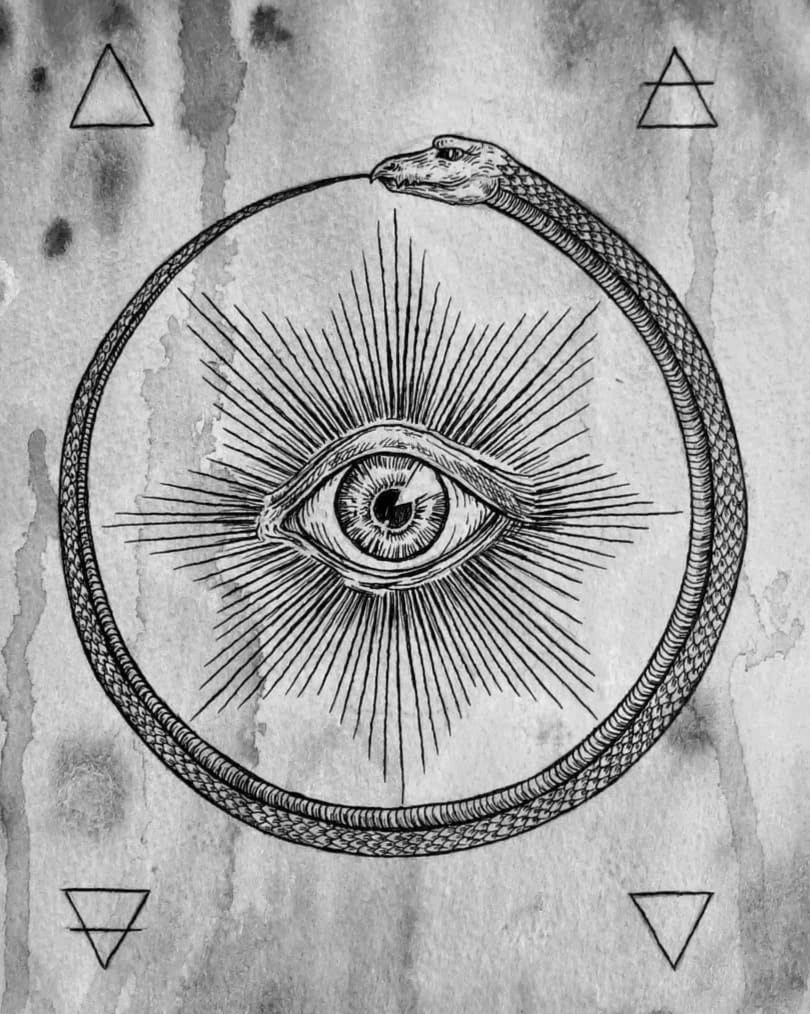
The book Thus Spoke Zarathustra was ultimately conceived to be about the notion of eternal recurrence. Karl Löwith asserts that eternal recurrence is the basic inspiration for the entire work in Zarathustra, where it is presented not as a hypothesis but as a metaphysical truth.
The subtitle Nietzsche intended to give to his main work, which includes Zarathustra, was “Noon and Eternity.” “Noon” signifies the supreme moment of fulfillment, the climax and crisis in which the vision of eternity becomes decisive once and for all. Zarathustra is portrayed as the prophet of eternal return, whose role is to transform the despair of modern nihilism into happiness through this saving doctrine.
The doctrine states that: “This life, as you live it now, as you have lived it, you must live again, and an infinite number of times; and there will be nothing new in it; but every pain and every joy, every thought and every sigh, everything that is infinitely great and infinitely small in your life must return to you, and all this in the same sequence and in the same order.”
An Ancient Idea
While reviving an ancient idea, Nietzsche’s version of eternal recurrence is profoundly and fatally altered by its new historical context. For the Greeks, it expressed a rational cosmic order; for Nietzsche, it is “the heaviest burden,” conflicting with his modern will and requiring a superhuman effort to love it. His attempt to reintegrate man back into nature or to reunite man’s destiny with cosmic fate was ultimately thwarted, as the doctrine fractures into two parts: a presentation as objective fact (to be demonstrated by physics and mathematics) and a subjective hypothesis (evidenced by ethical consequences).
This split occurs because we want to believe that our personal identity is important and enduring, but this does not fit with the idea of an indifferent, eternal universe that repeats itself endlessly and erases all uniqueness.
The three stages of the spirit in Nietzschean thought
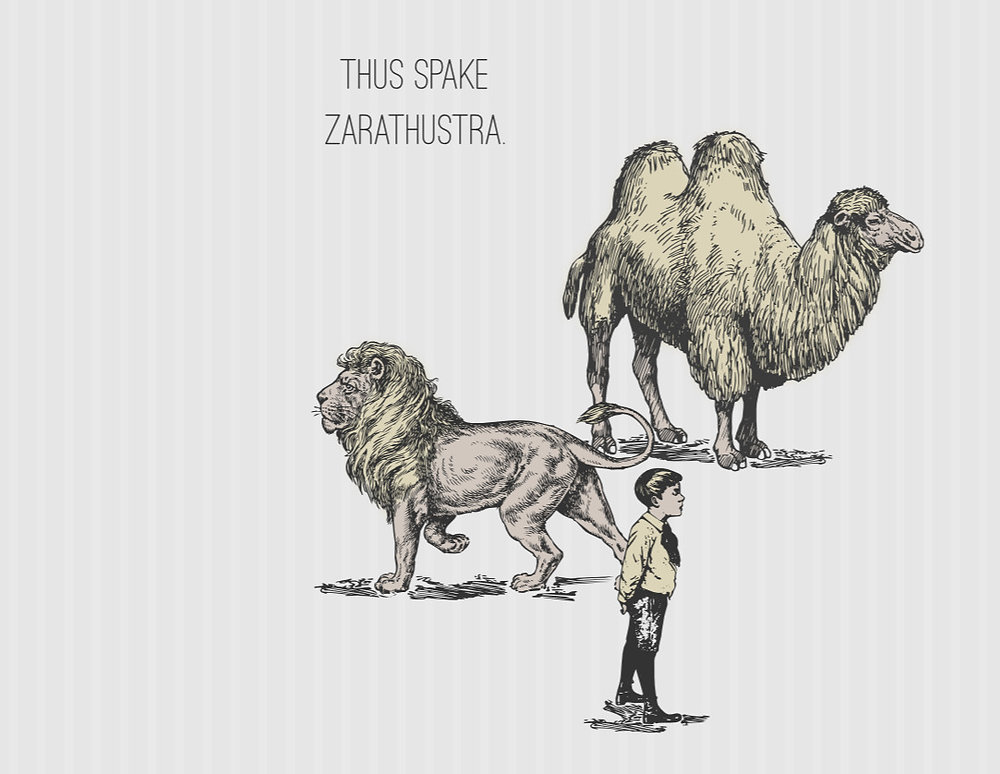
In Thus Spoke Zarathustra, Nietzsche presents both a philosophical allegory and a personal biography. The three metamorphoses, the camel, the lion, and the child, symbolize the evolutionary stages of the spirit in its struggle for freedom and creativity.
The camel represents the phase in which the spirit bears burdens, shows humility, and submits to inherited values and duties. It seeks out the hardest things and willingly embraces suffering, just as Nietzsche did in his early intellectual and personal struggles.
The lion is the rebellious spirit that says “No” to tradition and moral absolutes. It defies old values (the “You must” of the golden-scaled dragon) and fights to establish its own freedom. However, the lion cannot create new values, it can only destroy the old ones.
The last metamorphosis, the child, embodies innocence, playfulness, and the ability to create something new. Only the child, free from guilt and constraint, can utter a true affirmative “Yes” to life. This phase symbolizes Nietzsche’s idea of the Übermensch, that is, the one who overcomes nihilism and gives meaning to existence after the “death of God.”
Remarks Regarding the Metamorphoses
Eric Heller emphasizes that Nietzsche does not see these metamorphoses merely as an abstract theory, but as a deeply autobiographical process that reflects his own intellectual transformation. He also argues that Nietzsche never truly believed that he had reached the final stage, that of the child. He highlights the profound tension in Nietzsche’s philosophy: between the desire for creative affirmation and the awareness of the tragic absurdity of life, a struggle that makes the vision of the child both an ideal and, perhaps, unattainable.

5 thoughts on “The Death of God and the Creation of New Values”