General Information about the Book
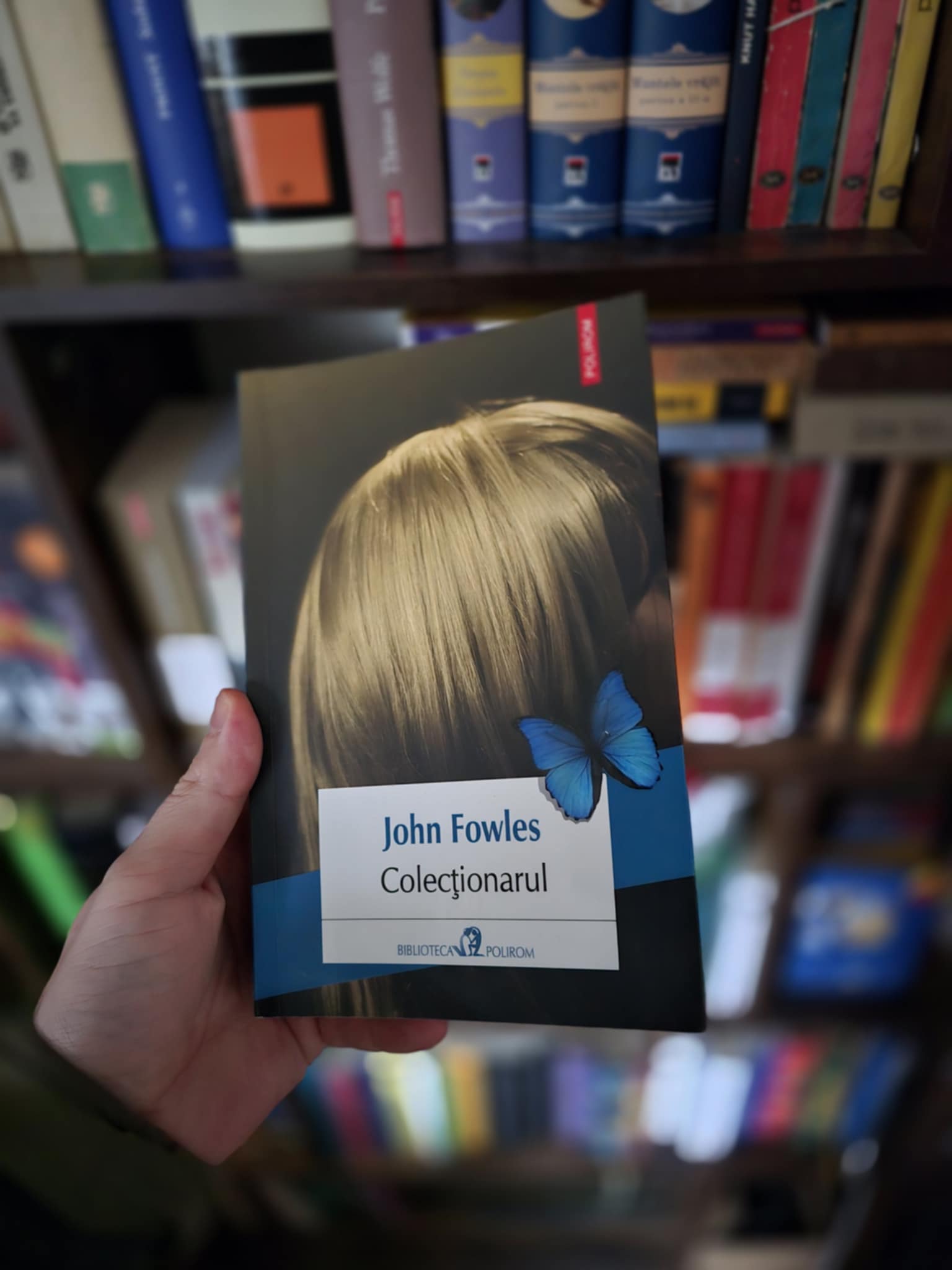
The collector is a haunting book that will make you foster hatred for a character more than you did or will do in any other book. At least this is my feeling. Hatred for Clegg and love for Miranda.
The idea for the novel originated from two distinct sources: a newspaper report about a real girl who was kidnapped and held in a London air-raid shelter for several days, and Béla Bartók’s opera Bluebeard’s Castle. From these foundations, Fowles explored the archetypal situation of an ogre-like man punishing a woman’s curiosity and disobedience. Additionally, the character of Frederick Clegg was modeled after the inarticulate hero prevalent in 1950s culture, such as James Dean or characters from Salinger and Sillitoe.
He wrote it quickly and published it before returning to his more complex work, later remarking that the book was primarily an exercise to demonstrate he could write well-enough to get published.
The novel is celebrated for its distinct two-part narrative featuring two unmistakably separate voices. However, the structure underwent a significant change before publication:
• The Original Manuscript: In the version first submitted to the publisher, the final sequences were part of the first section, meaning readers would have known of Miranda’s death before they even began reading her diary.
• The Final Version: Fowles agreed to separate the narrations to provide more suspense, though he maintained the isolation between the two perspectives to emphasize the claustrophobia of the characters.
A Brief Summary of the Book
The book is a psychological thriller told through the clashing perspectives of Frederick Clegg, a socially repressed clerk, and Miranda Grey, the art student he kidnaps. After winning a fortune in the football pools, Clegg uses his wealth to purchase a secluded cottage and prepare a cellar to house Miranda, whom he has long obsessed over as if she were a rare butterfly specimen. He believes that by removing her from her social circle, he can force her to eventually return his love.
The novel’s structure is divided into two distinct parts: Clegg’s clinical narration and Miranda’s subsequent diary entries, which reveal her intense claustrophobia and intellectual disdain for her captor. Their relationship represents a Heraclitean conflict between the “Aristoi” (the intellectual elite, represented by Miranda) and the “Hoi Polloi” (the conforming mass, represented by Clegg). Miranda attempts to collect Clegg back by educating him in art and morality, but she finds him utterly featureless and unimaginative.
A critical turning point occurs when Miranda attempts to seduce Clegg to gain her freedom. This assault on his sexual timidity shatters Clegg’s idealistic image of her, resulting in a great rift where he ceases to respect her, viewing her as just another ordinary woman. Shortly after, Miranda falls ill with pneumonia. Clegg’s paralyzing fear of being caught prevents him from seeking medical aid, leading to Miranda’s death. After burying her under his apple trees, Clegg discovers her diary and feels vindicated by her lack of love for him. The novel ends chillingly as Clegg begins planning to kidnap a new, less refined girl named Marian, whom he believes he can better teach.
Caliban
In Shakespeare’s The Tempest, Caliban is characterized as a savage beast and a half-creature who is not honoured with a human shape. He serves as the slave of Prospero, the play’s powerful magician figure.
A pivotal element of Caliban’s history in the play, which is mirrored in the themes of The Collector, is his attempt to violate the honour of Prospero’s daughter, Miranda. When confronted with this crime, Caliban unrepentantly remarks, “O ho, O ho! Would’t had been done!”. In Fowles’s novel, Miranda Grey adopts this name for her captor, Frederick Clegg, to highlight his lack of imagination, social clumsiness, and perceived intellectual inferiority. While Miranda uses the name as an expression of scorn, Clegg actually represents a conflation of both Prospero (the controlling jailer) and Caliban (the resentful, unrefined subject).
Clegg is a man from a lower-class with not much cultural education, no real ambition, and indeed, no imagination. He is not fostering life, but death. Clegg is unforgivable for his deed, and yet he is always capable of rationalizing his actions and behaviour. He even thinks high of himself saying: ” if more people were like me, in my opinion, the world would be better.” (p 13).
The Collector

The book starts with Clegg describing how mesmerizing Miranda is. His obssesion with her beauty reminds me of a passage from Nikolai Berdiaev in The Sense of Creation, where he says that what men are seeking in women is beauty, and that is precisely what they are thirst to adore, but without receiving it within them and making it part of their nature. In the cult of male love, what is planted in its core is divinization. “He wants me, my external appearance” (p 185).
Miranda is, in his view, everything to him. Without her he has nothing. “Miranda became the goal of my life” (p 23), he mentions. But what he does has no excuse. What I mean by that is that if you like someone, that persone does not owe you anything. And yet, Clegg intervenes in her life and by kidnapping her, he ads her to his collection. He stalks her and sees her as a prey, just like he does with the butterflies: “In the end I have waited about 10 days, as happens with butterflies” (p 28). Even his language is a predator language: “she was mine” (p 30).
Clegg is deeply conscious of his lower-class status and feels that people in posh restaurants and London at large despise him for his lack of a “la-di-da” voice. He views Miranda as a rarity to be collected precisely because of her refined speech and dainty ways, which he recognizes as markers of her social superiority. In this sense, he suffers from a complex of inferiority.
Miranda views Clegg as a victim of a miserable nonconformist suburban world characterized by stodginess and Calibanity. She expresses intense disdain for his shoddy taste in furniture and art, characterizing his middle-class aspirations as dead and square.
Clegg, as seen through the eyes of Miranda, has two big flaws, and these are guiding his social day to day behaviour. She mentions in her optimism and hope of getting away: “he will remain alone with all his neuroses: his sexual neuroses and his class neuroses” (p 229).
Miranda

Miranda is a brilliant art student described as radiant but incomplete. Physically, she has pale blonde hair, silky like cocoons, and grey eyes.
She can be seen as the opposite of Clegg. She desires to create and she loves life. All her time as a prisoner, she was thinking of how much she changed and how much more she will enjoy life. Her unfortune is that a maniac disrupts her normal existence by capturing her like a rare, beautiful butterfly and keeps her in isolation. “I am your prisoner. But you want me to be a happy prisoner” (p 39).
Intellectually and morally, Miranda represents the intellectual elite, and is described by some critics as a liberal-humanist snob and a secular saint. She identifies as a socialist and a pacifist, having participated in anti-nuclear marches, and claims to be a Buddhist who respects all forms of life. Despite these high-minded ideals, she is also sententious and possesses an air of righteous self-satisfaction, frequently using secondhand ideas and expressions “collected” from her mentor, G.P.
Miranda tries all in her power to regain her freedom: she tries to simply escape, she tries to speak her way out, she tries to send a very little note hidden in a letter, and her last card which she plays was using her sexuality. None of them work, which shows how dead inside is her captor and how much he lacks personality. “He is like rain; monotonous rain, which never ends” (p 187).
Similarities between Miranda and Clegg
The book can be approached from an ironic-absurdist view, which posits that the final outcome of the novel springs from the general condition of an indifferent world rather than individual character. In this view, both characters are non-believers who see the world as ruled by hazard or chance. Miranda’s defiance against a callous God is ultimately a doomed existentialist gesture because she is caught in a random chain of events she cannot alter.
Another approach is the mirror interpretation. The novel can be read as a study in variations, where Miranda is not Clegg’s opposite, but a variation of his own character. Both characters are described as: a)symbolic collectors: Clegg collects butterflies while Miranda “collects” the ideas and expressions of her mentor, G.P.; b)shared conviction of superiority: both use their sense of refinement to justify callousness toward others; c)shared obsessions: they both hate dirt, are uncomfortable with bodily functions, and initially view sex as disgusting or corrupting.
Other Approaches
The book is often approached as an ugly parody of courtly love, a medieval tradition where noble love is never consummated and exists as a game without a prize. Clegg represents an ironic foil to the romantic lover, viewing his capture of Miranda as a way to worship her from a distance. The tragedy is precipitated when Miranda threatens his idealized spiritual love by attempting to offer him physical sex.
The novel also explores the archetypal Bluebeard situation, where an ogre-like man punishes a woman’s curiosity. From a Jungian perspective, the relationship illustrates a failure in communication that condemns individuals to separate and impenetrable subjective worlds. The cellar-dungeon functions as a symbol of mental alienation and the isolation of the subject.
Final Remarks
First of all, I want to confess that I have never hated any fictional character as much as I hate Clegg. I think he is constructed in such a way that you cannot but hate him. So, in this sense, you, as a reader, are as much of a prisoner as Miranda. The author gives you no escape!
Whatever the main intent of the author was when writing his debut novel, my view reading of his text is about the relationship between men and women. Throughout time in history, a lot of women went into marriages just to become dead butterflies. Their social position was limited to the role of the ideal housewife. But as we can see with Miranda, she is eager to learn, to grow, to live, to create, meaning she is more than her imposed limitations. Clegg/Caliban is a man dead inside with not much going for him. It just so hapens that he wins a great deal of money, him of all people, and gets to do whatever he pleases.
Miranda explicitly states on multiple occasions that Clegg is the real prisoner, despite his role as her captor. During a discussion about religious belief, she tells him directly, “You’re the one imprisoned in a cellar” (p 66). Later, in her diary, on 10th of November, she reflects that Clegg is trapped by his own limited perspective, writing that he “doesn’t believe in any other world but the one he lives in and sees” (p 249) and concluding that “he’s the one in prison; in his own hateful narrow present world” (p 249).
A crazy thing occuring in my mind was about a strategy Miranda never used. But Clegg might have seen that as dirty and animal-like, just as he believed about her when she undressed in front of him. Although that was a problem of sexuality, what I had in mind was a bit different. We might think that whatever stands on a pedestal must not be desecrated. How?
Well, she could have broken the illusion she is an angel by taken a pee in the middle of the room or farting while speaking to him. Why not? We do speak about her freedom after all. She might have been seen as an angel by her captor, but she is still a human. Am I wrong here?
Anyways, what are your thoughts on this book? What do you think about the two characters?