Introduction
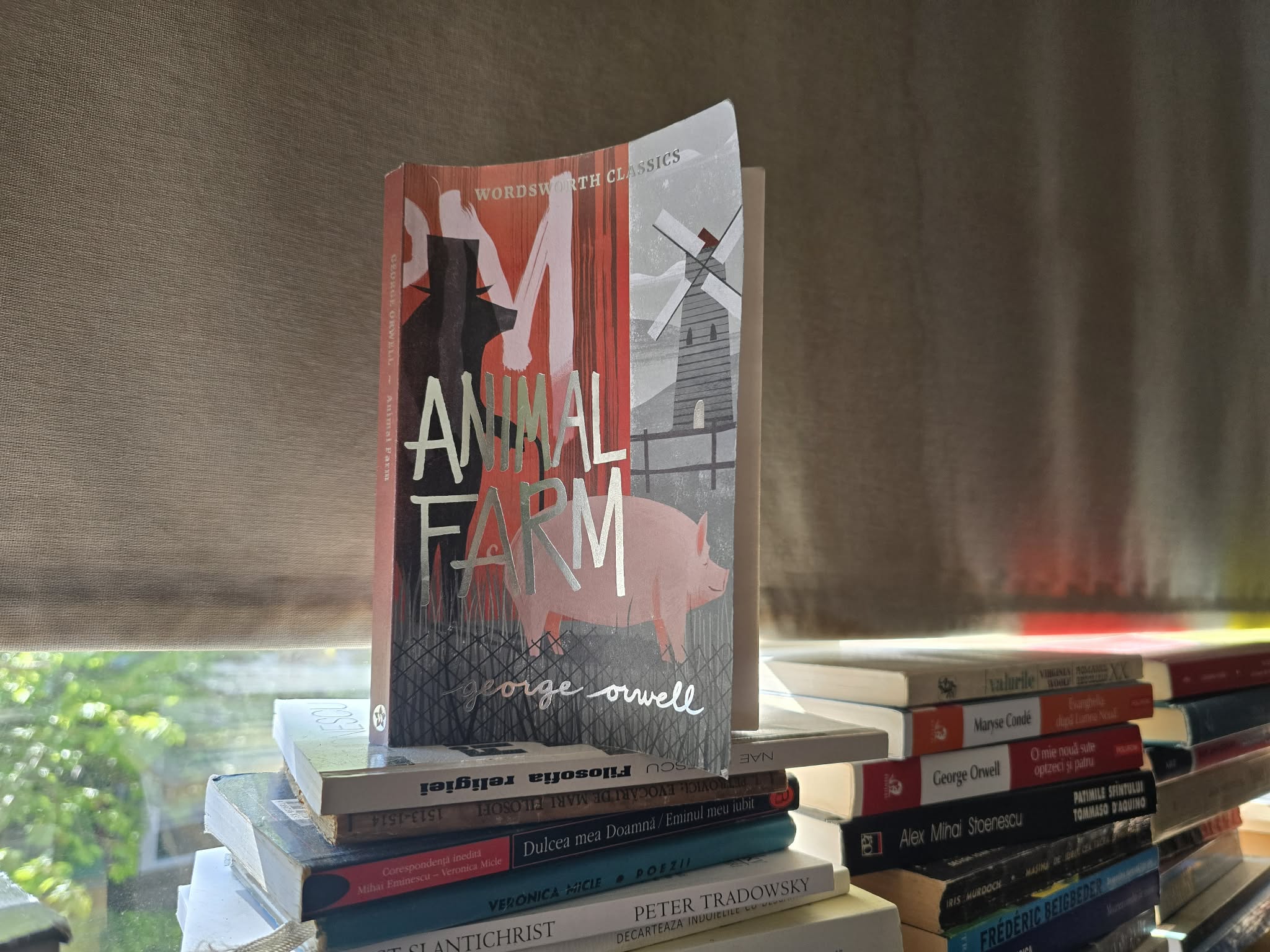
George Orwell’s Animal Farm, subtitled “A Fairy Story,” is a political novella written between 1943 and 1944. It is a dual-purpose work that fuses political intent with artistic strategy by utilizing the genres of the fable and fairy tale. Primarily, the book serves as a transparent allegory and satire of the Russian Revolution and the subsequent betrayal of socialist ideals by the Soviet regime. It features animal protagonists, such as the pigs Napoleon and Snowball, who represent historical figures like Stalin and Trotsky. Central to its narrative is the investigation of equality, particularly through the famous paradox that some animals are “more equal than others”.
Orwell faced significant publication challenges during wartime Britain due to the book’s anti-Stalinist message, resulting in several rejections before Frederick Warburg published it in August 1945,. Ultimately, the novella functions as long-range literature that serves as a universal warning against power-seekers who use theoretical jargon to establish tyranny.
Summary of the Book
Inspired by the prize boar Old Major, who envisions a classless society free from human tyranny, the animals establish Animalism governed by Seven Commandments, the most sacred being that “All animals are equal”. However, leadership soon falls to the pigs, Napoleon and Snowball, who are viewed as a natural aristocracy due to their superior intelligence.
The revolution’s betrayal begins when the pigs privatize milk and apples for themselves, using “Science” (milk and apples contain nutrients essential for the health of brainworkers, thereby justifying their exclusive privilege to consume these resources as a necessity for the farm’s management) and the fear of Jones’s return to justify their privilege. Napoleon eventually seizes total power by using a private army of dogs to exile Snowball, ending democratic debates and establishing a managerial tyranny. The loyal workhorse Boxer represents the exploited proletariat, remaining faithful to the regime until he is sold to the knacker’s once his strength fails; the pigs then use the proceeds to buy whiskey.
As the pigs adopt human habits, the commandments are secretly altered, eventually culminating in a single paradox: “All animals are equal, but some animals are more equal than others”. The novella ends with a banquet where the pigs and human farmers reconcile. As the other animals peer through the farmhouse window, they realize the revolutionaries have become indistinguishable from the original oppressors, completing a process of “pig to man”.
The Seven Commandments
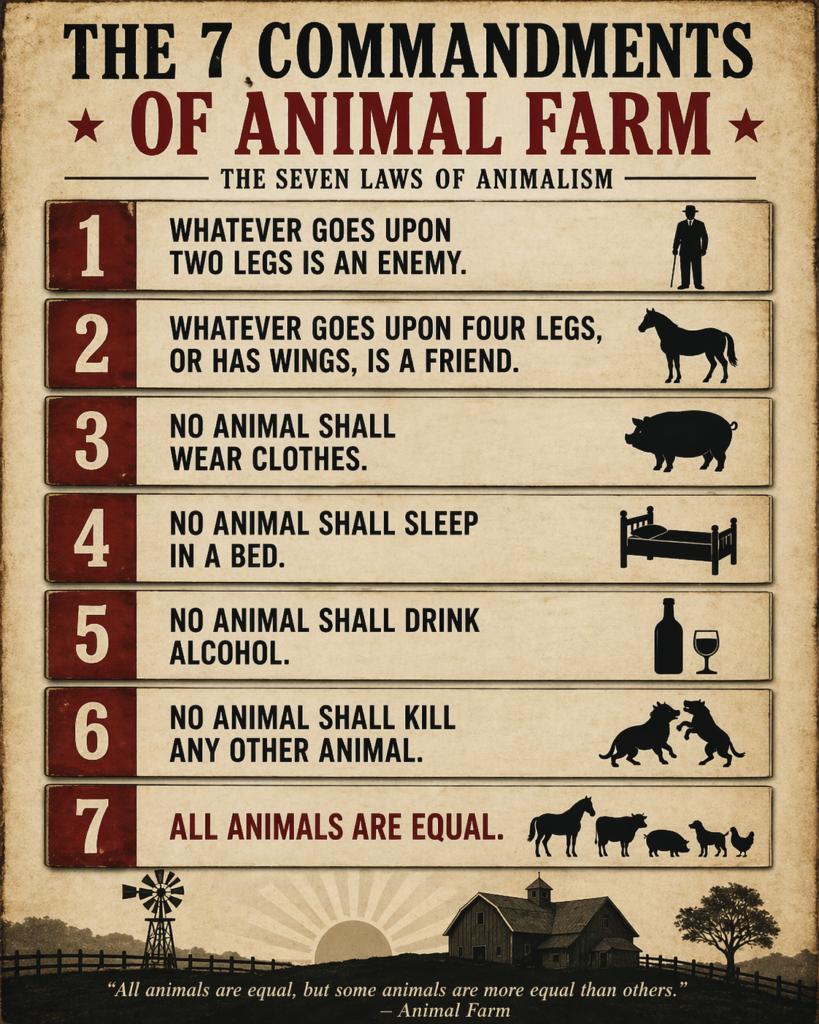
The Seven Commandments were written shortly after the successful Rebellion and the expulsion of Mr. Jones. After the pigs revealed that they had taught themselves to read and write over the previous three months, Snowball and Napoleon called the animals together at half-past six on the morning the hay harvest was to begin. Snowball, who was the best at writing, climbed a ladder and inscribed the commandments in great white letters on the tarred wall of the big barn, explaining that they would form an unalterable law for Animal Farm forever.
The Seven Commandments, as originally written on the wall, are:
- Whatever goes upon two legs is an enemy.
- Whatever goes upon four legs, or has wings, is a friend.
- No animal shall wear clothes.
- No animal shall sleep in a bed.
- No animal shall drink alcohol.
- No animal shall kill any other animal.
- All animals are equal.
The Seven Commandments serve as the unalterable law of Animalism, designed to codify the animals’ instinctive vision of a fair society following the Rebellion. They function as a law of laws, providing both the motive and form of justice based on universality: the idea that a rule for one must be a rule for all.
The commandments are intended to preserve animal justice by rejecting human habits, such as wearing clothes, drinking alcohol, or sleeping in beds. The most sacred is the Seventh Commandment: “All animals are equal”, which attempts to fix a standard of likeness across different species.
The laws represent the gap between principle and practice. The pigs gradually alter the commandments to justify their own managerial privilege and biological status, eventually reducing them to a single meaningless absurdity regarding some animals being “more equal” than others.
Final Thoughts
I can say about Animal Farm that is as dark as 1984, although it does not have the same impact. But paradoxically, I can say that it is not as dark as 1984 but has the same impact. Between the lines you can see similar characteristics, as if these two books would share a common universe.
It is interesting how the story mirrors a fairly familiar reality, namely that while dreaming of a better (or democratic) world, what actually happens is a simple transition from one regime of terror to another, by only replacing those in power. They promise many good things, but the promises are actually made only to them, not the everyone. Does it remind you of anything in particular?