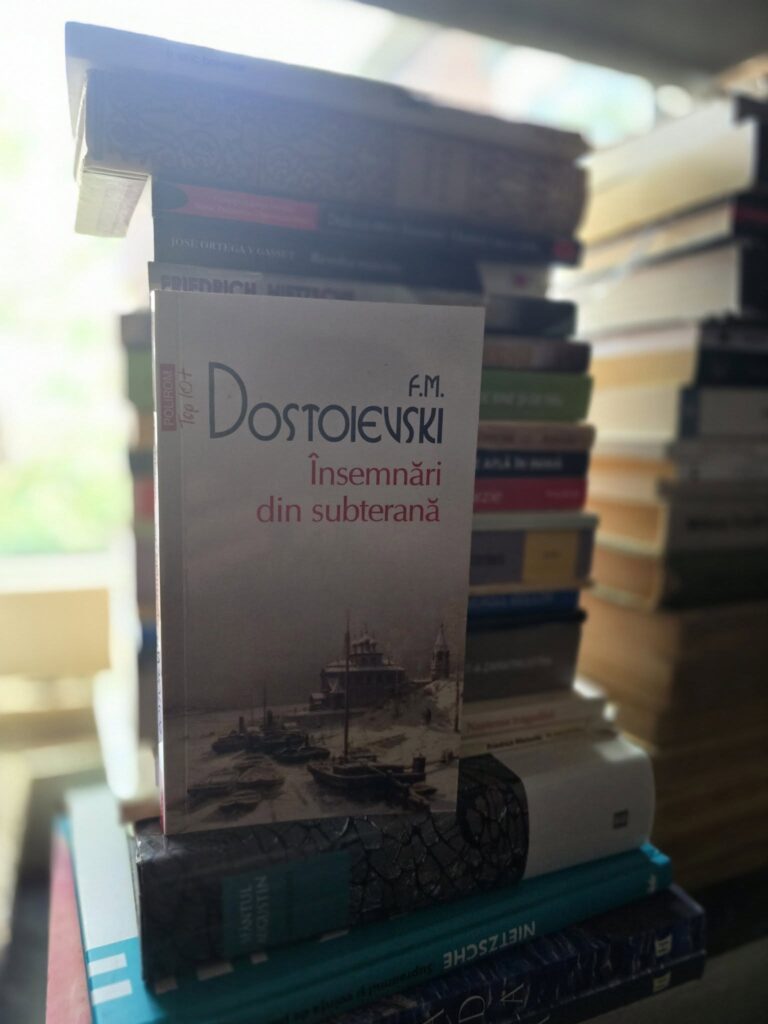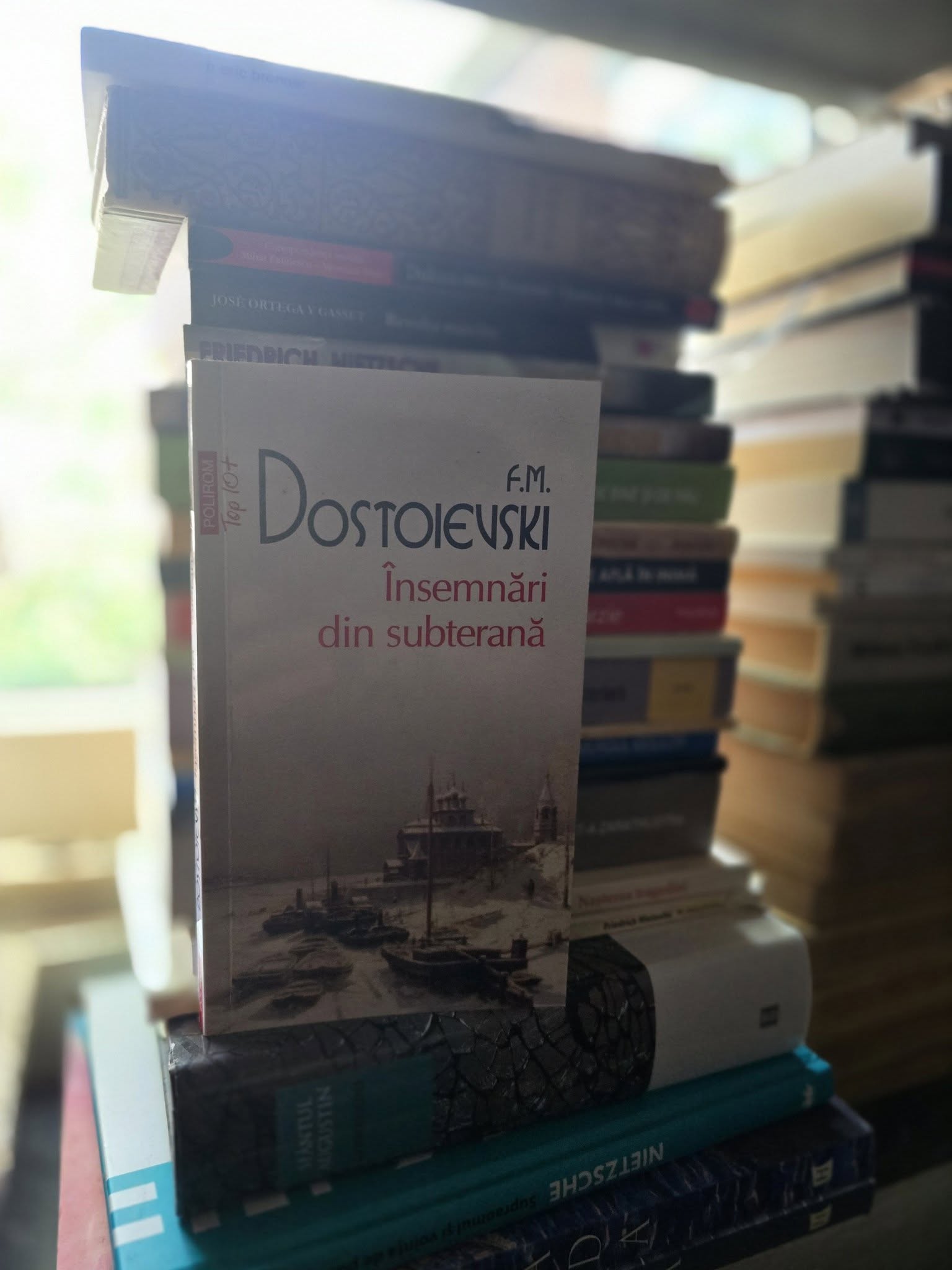
Notes from Underground is a novella written by Dostoievski, one of the greatest writers of all time. The citation in this article is based on the Romanian copy I own.
The Underground and Underground Folks
The underground refers to a metaphorical corner, hole, or cellar where an individual retreats from society into a state of conscious inertia. It is a psychological space characterized by a hell of unsatisfied desires turned inward and a fever of oscillations, where one remains buried alive for decades in a state of hopeless, spiteful isolation. It is an active form of unparticipating to life.
Underground folks are the individuals who inhabit this state, and the unnamed narrator notes that they positively must exist in modern society given its current formation. They are defined by several key characteristics:
- Over-acute Consciousness: They possess a level of awareness that is described as a real thorough-going illness. This hyper-consciousness leads to inertia, as they are unable to act because they endlessly question every primary cause behind their actions.
- Divorce from Real Life: These individuals feel a deep loathing for real life, viewing it as a burden or an effort. They prefer the safety of books and abstract ideas over the messy reality of having a “real individual body and blood”(p 173).
- Characterless and Stillborn: The Underground Man argues that a decent man of the nineteenth century must be a characterless creature. He describes his kind as stillborn, begotten by theories rather than living fathers, and suggests they are developing a taste for this artificial existence.
- Spiteful Individuality: In their nasty, stinking, underground home, they nurse an everlasting spite for forty years, refusing to reconcile with the laws of nature or mathematical certainties that seek to define them as mere piano-keys.
The Most Advantageous Advantage
We have to ask ourselves why is Dostoievski so eager to fight for the notion of free will. Dostoievski saw a dangerous trend emerging in the nineteenth century: the belief that human beings could be explained entirely through science, biology, economics, and social laws.
He rejected this view, arguing in essence that no matter how perfect our theories about human nature may be, people will sometimes do the exact opposite simply to prove that they are free:
“For if a desire should come into conflict with reason we shall then reason and not desire, because it will be impossible retaining our reason to be SENSELESS in our desires, and in that way knowingly act against reason and desire to injure ourselves” (p 38).
Dostoievski’s point is that human beings cannot be reduced to perfectly rational creatures. Any system that ignores human freedom and the contradictions inherent in human nature is ultimately doomed to fail.
The Underground Man defines the “most advantageous advantage” as one’s own free and unfettered choice, including one’s own caprice, however wild, and one’s own fancy, even when worked up to a frenzy. He argues that this specific advantage is consistently omitted by statisticians and lovers of humanity because it does not fit into any rational classification or list of human benefits, such as prosperity, wealth, freedom, or peace.
Although inspired by Dostoievski, Nietzsche was against the notion of free will. If you are interested in reading a bit about that, please check my review on Twilight of the Idols.
The Holy Prostitute as an Archetypal Character
Liza is one of the novel’s most important characters. Through her, Dostoievski introduces one of the most recognizable character types in his works: the socially marginalized woman who is morally superior to those who judge her. She foreshadows an archetype that Dostoievski would later develop more fully in Crime and Punishment: the “holy prostitute.” Although she is a prostitute, Liza embodies compassion, sincerity, and the possibility of redemption through love. Through her character, Dostoievski suggests that true moral nobility is often found in those whom society chooses to marginalize.
The crucial difference is that while Raskolnikov eventually accepts Sonia’s love, the Underground Man rejects Liza’s compassion, making her failure one of the novel’s central tragedies.
He rejected Liza’s love primarily out of a deep sense of shame and spite, as he felt humiliated that she had witnessed his beggarly and pathetic reality after he had posed as a hero. He also confessed that he was incapable of any love that did not involve tyrannising over another person, ultimately choosing the solitary peace of his “underground” existence over the overwhelming novelty of real life.
The End of the Book
“We are stillborn, and for generations past have been begotten, not by living fathers, and that suits us
better and better. We are developing a taste for it. Soon we shall contrive to be born somehow from an idea” (p 173-174).
In the novel’s concluding passage, Dostoievski criticizes a society that has become alienated from authentic life and dominated by rational abstractions. As a result, human beings risk becoming products of ideas and theories rather than of lived experience and their own freedom. It is thus the Underground Man’s final indictment of a society that has become completely divorced from real life and organic human experience.
Being stillborn suggests that modern individuals lack vital, natural roots; instead of being shaped by flesh-and-blood experience or heritage, they are products of intellectual theories and literature. To be born from an idea means replacing the individual body and blood with abstract concepts and mathematical formulas, effectively turning humans into the impossible generalised man or piano-keys he previously mocked. What he asserts is that people are developing a taste for this artificiality because real life has become a burden, leading them to feel more comfortable existing as theoretical constructs than as living, breathing men.