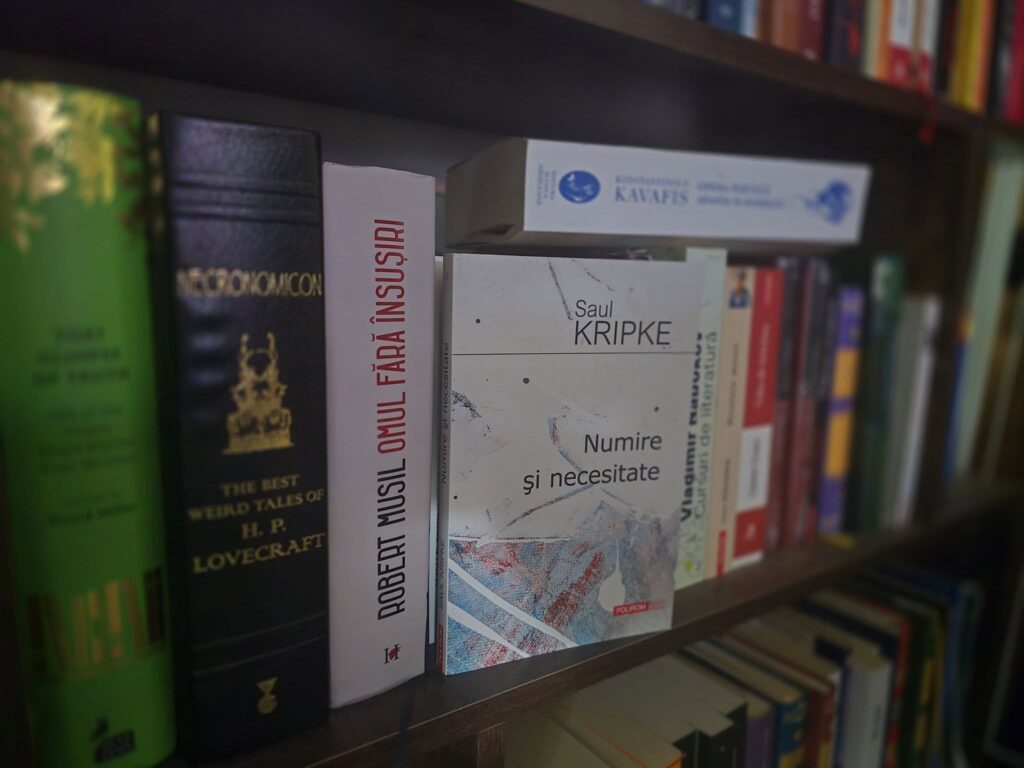
Meeting Kripke
I have to admit that I have before me one of the books that I consider difficult to read. Actually, to avoid making a mistake, I should specify that it is difficult to digest. It belongs to the tradition of analytic philosophy in which Kripke connects naming with necessity through the concept of rigid designators. Proper names are rigid designators because they designate the same object in all possible worlds.
Therefore, true identity statements involving names (Hesperus is Phosphorus) are metaphysically necessary. In this way, Kripke separates necessity from a priori knowledge, showing that there are truths that are necessary but can only be known a posteriori, that is, through experience.
I know about Kripke through Kant, who argued that there are several types of knowledge based on the distinction between two kinds of judgment, analytic/synthetic and a priori/a posteriori. According to Kripke, however, there are also contingent a priori truths (the very interesting example in the book is why is the meter as long as we say it is?) and necessary a posteriori truths (water is H₂O, gold has atomic number 79, etc.).
I was wondering why Kant, or the critics of his time, did not think of something like this. Did they perhaps simply lack the intellectual tools to do so? The notion of a possible world already existed with Leibniz, but when it comes to the science of chemistry, things are somewhat different.
Independent faculties of chemistry appeared much later, in the nineteenth century, alongside the professionalization of the scientific disciplines.
This context explains why Kant considered mathematics and physics to be paradigmatic examples of sciences, while he was more reserved about chemistry. In fact, he argued that chemistry was not yet a proper science because it lacked a sufficiently rigorous mathematical foundation. In his time, chemistry was still largely an experimental and descriptive science, rather than one capable of deducing laws with the precision of Newtonian mechanics.
This is also one of the reasons why Kripke’s examples would not have been available to Kant: the concept of molecular structure and the formula H₂O were established only in the nineteenth century, following the development of modern chemistry.
Kant and Kinds of Judgement
Kant distinguishes between two kinds of judgment: analytic and synthetic, and between two kinds of knowledge: a priori and a posteriori. This gives us three important categories: analytic a priori knowledge, synthetic a priori knowledge, and synthetic a posteriori knowledge. For Kant, mathematics provides the clearest example of synthetic a priori knowledge, since mathematical truths are necessary yet do not depend on empirical experience.
Kripke complicates this picture by separating necessity from a priori knowledge. He argues that there can be contingent a priori truths, such as his famous meter-stick example, as well as necessary a posteriori truths, such as “water is H₂O” or “gold has atomic number 79.” In this way, Kripke shows that what is necessary does not always have to be known a priori, and what is contingent does not always have to be known through experience.
In any case, what should be kept in mind is that we need to distinguish between epistemological questions (how we know a truth: a priori or a posteriori) and metaphysical questions (what kind of truth it is: necessary or contingent). The traditional mistake was to identify these two classifications, assuming that every a priori truth is necessary and every a posteriori truth is contingent. Kripke shows that they are independent, since there are both necessary a posteriori truths and contingent a priori truths.
And since I have mentioned Kant, I should also note that in the third lecture, Kripke criticizes Kant’s idea that the statement “gold is a yellow metal” is an analytic truth known a priori. He argues that yellowness is not part of the essence of gold, but merely a contingent property through which we identify this substance in our world.
Instead, the essential property of gold is its atomic structure (atomic number 79), a fact discovered empirically but necessary in all possible worlds. What Kripke is therefore arguing is that scientific discoveries reveal the essence of a substance, that is, its fundamental internal structure. Although we initially identify gold through contingent properties such as its yellow color, its true nature is determined by atomic number 79. Since “gold” is a rigid designator, the term refers to the same substance in all possible worlds. Therefore, any substance that does not have atomic number 79 is not gold, making this identification metaphysically necessary, even though it is discovered a posteriori.
Rigid Designators
A rigid designator is a term that designates the same object in every possible world in which that object exists. Kripke argues that names and natural kind terms are rigid, unlike descriptions, which can refer to different objects counterfactually.
This matters because it separates metaphysical necessity from epistemological apriority. It demonstrates that identity statements between rigid designators are necessary a posteriori truths. Therefore, scientific discoveries about a substance’s essence are necessary, and the mind-body identity thesis is challenged because mental states cannot be contingently identical to brain states.
At the time of his lectures, held in 1970, 9 was indeed the number of planets in our solar system, but Kripke argued that this was merely a contingent fact, something that is true in our world but could have been different in another possible world.
Kripke uses the example of the number of planets to illustrate the difference between rigid and non-rigid designators. The number 9 is a rigid designator: it refers to the same number in every possible world. By contrast, the description “the number of planets” is non-rigid because its reference can change. In a possible world with only eight planets, “the number of planets” would refer to 8 rather than 9. Therefore, although 9 was the number of planets in our world for many years, this was only a contingent fact, not a necessary one.
This example shows why a name or number cannot simply be equated with a description. “9” always refers to the number nine, whereas “the number of planets” can refer to different numbers depending on how the world is. The reclassification of Pluto in 2006 provides an interesting real-world illustration: what we once described as “the number of planets” was 9, but today it is 8. The number 9 itself, of course, has not changed.
Final Thoughts
The central aim of the book is to challenge the traditional idea that names get their meaning from descriptions. Kripke argues that a proper name such as “Aristotle” does not mean “the teacher of Alexander” or “the author of the Metaphysics.” Instead, the name refers rigidly to the same individual across possible worlds.
From this, Kripke develops a larger distinction between necessity, possibility, and knowledge. He argues that these should not be confused with the epistemological distinctions between a priori and a posteriori knowledge. This leads to his famous examples of necessary a posteriori truths, such as “water is H₂O,” and contingent a priori truths, such as the standard-meter example.
The book is important because it changes how philosophers think about language, reference, identity, possibility, and necessity. It also has consequences for metaphysics: scientific discoveries can tell us something about the essential nature of things, rather than merely describing how things happen to appear in our world.
In other terms, Kripke’s main message is that the way we know something, the way we refer to it, and what is necessarily true about it are three different questions. That is what makes Naming and Necessity so influential.