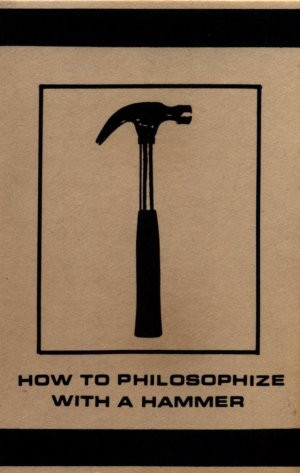
Philosophizing With the Hammer
Is philosophizing with a hammer just about breaking down old ideas and beliefs? Is it about breaking down and building up at the same time? Could this tool even be a medical one, like a reflex hammer? Lots of images come to mind, some of them straight from Nietzsche himself. But what I like to believe (still) is that at the same time, this procedure (philosophizing with a hammer) produces an echo, that is, it leaves behind (or ahead, if we are to remain faithful to the metaphor) an impact.
Especially if we consider the aphorism in this book: “posthumous people are less understood than those in step with the times, but better HEARD.” It is no wonder, once again, that Nietzsche himself proposes a philosophy of the future; the echo of his time reverberating into the future. The proposal, however, is not forced, no one is threatened with a hammer or any instrument of torture. Nietzsche is not like the man of faith who tries with all his might to convert humanity wherever he looks.
This reminds me of the story of the 28-year-old missionary who wanted (with no turning back) to preach the Gospel to the most remote tribe in the world, which is protected by Indian law. He never made it back home…
Few Things about Nietzsche
Nietzsche, who proclaims himself the teacher of eternal return, is the kind of thinker who does not seek distance but a break from old systems of thought. He seeks a total break from old philosophical and religious ideas. And it is possible that he did not know those he criticizes in an academic sense, but rather does so based on intuition. What he read in its entirety and with passion was the Bible (in which he admires the Old Testament but despises the New) and Schopenhauer’s seminal work.
What else can we say about Nietzsche? In his last year of lucidity, he distanced himself from close relationships, especially his sister Elisabeth, because of her marriage to the anti-Semitic Bernhard Förster, whose propaganda he despised. In the months before his collapse in January 1889, heightened sensory perception accompanied his focus on psychology and the completion of The Will to Power.
The Will to Power
Nietzsche initially intended to publish The Will to Power as his magnum opus, classifying his notes for it in 1888. However, by mid-September he had abandoned this plan, and his preferred title became The Revaluation of All Values. The Twilight of the Idols (originally titled A Psychologist on Vacation) appeared as a shorter and more cheerful introduction to his philosophy, including material that was originally intended for The Will to Power.
The manuscript was sent in September 1888, with Nietzsche considering it a “return” compared to The Revaluation of All Values. Also by mid-September, he had written most of The Antichrist, which he had planned as the first volume of his great project. By the end of November, he realized that The Antichrist actually represented the entire Revaluation.
The new title, The Twilight of the Idols, is a play on words inspired by Wagner’s The Twilight of the Gods. The work is characterized as a collage hastily put together due to its composition of selected materials, lacking a clear line of thought but serving as a summary of his philosophy. The text contains numerous references to power, emphasizing implicitly rather than explicitly the will to power; Nietzsche links the decline of institutions and society to the undermining of the will to power.
About the Chapters of the Book
Inthis work, Nietzsche aims to deliver a sharp and accessible summary of his philosophical project. a crash course in revaluating Western values. He attacks the “idols” of traditional morality, religion, and philosophy, especially Socratic and Christian ideals, exposing them as life-denying illusions. His goal is to clear the way for a new, life-affirming philosophy that celebrates strength, creativity, and the vitality of the human spirit.
“Maxims and arrows”
The first chapter seems to show a lack of order and give the impression of a thinker telling jokes. Nietzsche himself considers himself an expert in aphorisms and maxims, and sees them as essential to his style, even to his philosophy. “They are forms of eternity,” he writes; “my pride lies in saying in ten sentences what anyone else says in a book, what anyone else does NOT say in a book…” (p. 129).
Through his maxims, Nietzsche proves himself to be a psychologist who deconstructs morality and ideals. Through his position as a genealogist (or psychologist of history), he discovers truth to be not fixed and eternal as metaphysics asserts, but multiple and ambiguous. This shows that the human sciences always capture and speak about objects, people, and realities that are constantly in motion. We ourselves are fluxes speaking about fluxes.
“The Problem of Socrates”
Nietzsche presents Socrates as a symptom of Greece’s decline rather than a model of wisdom. He describes him as ugly and of modest origins, suggesting that his dialectic was a last resort and a form of revenge by the plebs against the nobility. Nietzsche criticizes the Socratic equation “reason = virtue = happiness” as bizarre and a sign of decadence, forcing a tyrant of reason against healthy instincts. Socrates is portrayed by Nietzsche as a “doctor” who, although fascinating, offered a cure (reason) that was, in fact, an even more serious disease. “Socrates himself was nothing but sick for a long time…” (p. 28).
“Reason in Philosophy”
Nietzsche criticizes the fundamental errors of traditional philosophers, extending his criticism to Socratic rationalism. He argues that philosophers often dehistoricize concepts, turning them into mummies and denying the reality of becoming. “What is, does not become; what becomes, is not…” (p. 29). According to Nietzsche, the senses do not lie; instead, reason falsifies their testimony, leading to a belief in a “true world” that is nothing but a lie added to the only real world, the “apparent” one.
“How the true world finally became fiction”
Nietzsche describes in six stages the process by which the “true world” became a fable, the last being his absolute affirmation of appearance:
1. Plato – the true world is that of Ideas, whose ensemble constitutes moral, political, and religious Good.
2. Christianity – that is, according to the German philosopher’s view, Platonism for the people, more precisely, the vulgarized version of Platonism from which the spirit-body dualism is adopted. What is dualistic in Christianity is a Platonic legacy transformed into religion.
3. Kant – from Nietzsche’s point of view, the Kantian philosophical project, that is, transcendental idealism, is nothing more than a form of rethought Christianity, a Christianity dressed in different clothes (words).
4. Positivism – what cannot be known as fact does not exist. Thus, morality can only be based on facts, religion is a myth, and only science can be salvation.
5. Nihilism – the death of God, the preliminary phase of the destruction of old values before the affirmation of new ones.
6. Nietzsche – he rejects the dualism of truth and appearance. Humanity must believe in reality without idols; thus it can reach its own zenith, that is, the Übermensch.
“Morality as Anti-Nature”
In this chapter, Nietzsche considers the church to be nothing less than hostile to life, something he mentioned earlier in the preface to his first book. “The church combats passion through extirpation in every sense: its practice, its therapy is castration” (p. 40). Morality is condemned as a specific error and a degenerate idiosyncrasy that causes unimaginable damage. Nietzsche contrasts this with the “instinct for life” of naturalism, proposing immoralists as a natural alternative.
Next, he discusses what he calls “the four great errors”. What are they?
“The Four Great Errors”
1. Confusing cause and effect – such as the belief that virtue produces happiness, when in fact it is an effect of a well-lived life. (For reading more about causality, I advice you read my first article, Moral Responsibility in a World without Free will)
2. False causality – the illusion that conscious will or the “ego” are real causes, which Nietzsche considers to be optical illusions projected onto the world; in reality, there are no spiritual causes for human behavior.
3. Imaginary causes – that is, the invention of comforting explanations for feelings or events, often of a religious or moral nature, generated by the need to alleviate fear.
4. Free will – “the most dubious theological trick of all, designed to make humanity responsible” (pp. 55-56). More specifically, he criticizes the idea of free will, which he considers a ploy by theologians to assign blame and punishment. “Christianity is a metaphysics of the hangman” (p. 57).
“The Improvers of Mankind”
Nietzsche argues that morality, especially Christian morality, is a deceptive tool used to tame and weaken individuals. He claims that the “humanizers,” such as priests, transform the “blond beast” into a sinner. He concludes that all methods used to make humanity moral have been fundamentally immoral, stemming from a petty Tschandala-like resentment.
“What the Germans lack”
Nietzsche criticizes Germany’s cultural and intellectual decline, attributing it to a deliberate dumbing down that has been going on for almost a thousand years. He blames alcohol, Christianity, and even Wagner’s music for dulling the German mind. Nietzsche laments the loss of serious thinking and criticizes the education system for failing to produce true educators, favoring mediocrity and a lack of refined thinking. He emphasizes the importance of learning the art of seeing, thinking, speaking, and writing with patience and precision, skills he finds sorely lacking in his flatland Germany.
“Skirmishes of an Untimely Man”
This is the longest chapter of the book, in which Nietzsche presents a fragmentary but comprehensive summary of his philosophy, using material originally conceived for The Will to Power. He criticizes numerous intellectuals and cultural figures, from Seneca to Zola, often highlighting their spiritual errors and decadence. The chapter explores the physiological foundations of art and morality, contrasting Apollonian and Dionysian intoxication. Nietzsche discusses the nature of genius, freedom, and the criminal type, emphasizing the centrality of the will to power and the body. He contrasts his “return to nature” with that of Rousseau, criticizes German culture, and ultimately praises Goethe as a rare realist.
“What I Owe to the Ancients”
In the concluding chapter, Nietzsche expresses his admiration for the Roman style and Greek Dionysian art. He highlights his debt to the Roman style and realism of Thucydides, contrasting them with Plato’s “supermoralizing” idealism. “For him, the notion of good is already the supreme notion” (p. 133). He praises the Dionysian will to live of the Greeks, embracing their orgiastic and sexual vigor. This affirms instinct and is essential to the revaluation of values and the concept of eternal return.
In conclusion, Nietzsche, who always places himself in the position of genealogist, highlights the fact that we are subject to weak and neurotic values, and that our ideals ring hollow when questioned with a hammer. Nietzsche, however, would not be the first to criticize philosophy. Kant had already done so before him, posing the question as follows: what right do I have to assert one philosophical proposition or another, and to what extent?
Nietzsche takes up the question and radicalizes it: which type of will, body, or instincts asserts itself, the strong or the weak? Which of them is expressed in one philosophical proposition or ideal or another? Nietzsche opposes the morality that he denounces when it does not recognize its unconscious origin. Hence the proposal for new goals and values. Hence the need to remain an inactual, one who shakes idols, announcing their decline and opening paths, chiseling with a hammer the statue of a new type of humanity.

2 thoughts on “Twilight of the Idols: A Great Declaration of War”