Introductory Thoughts
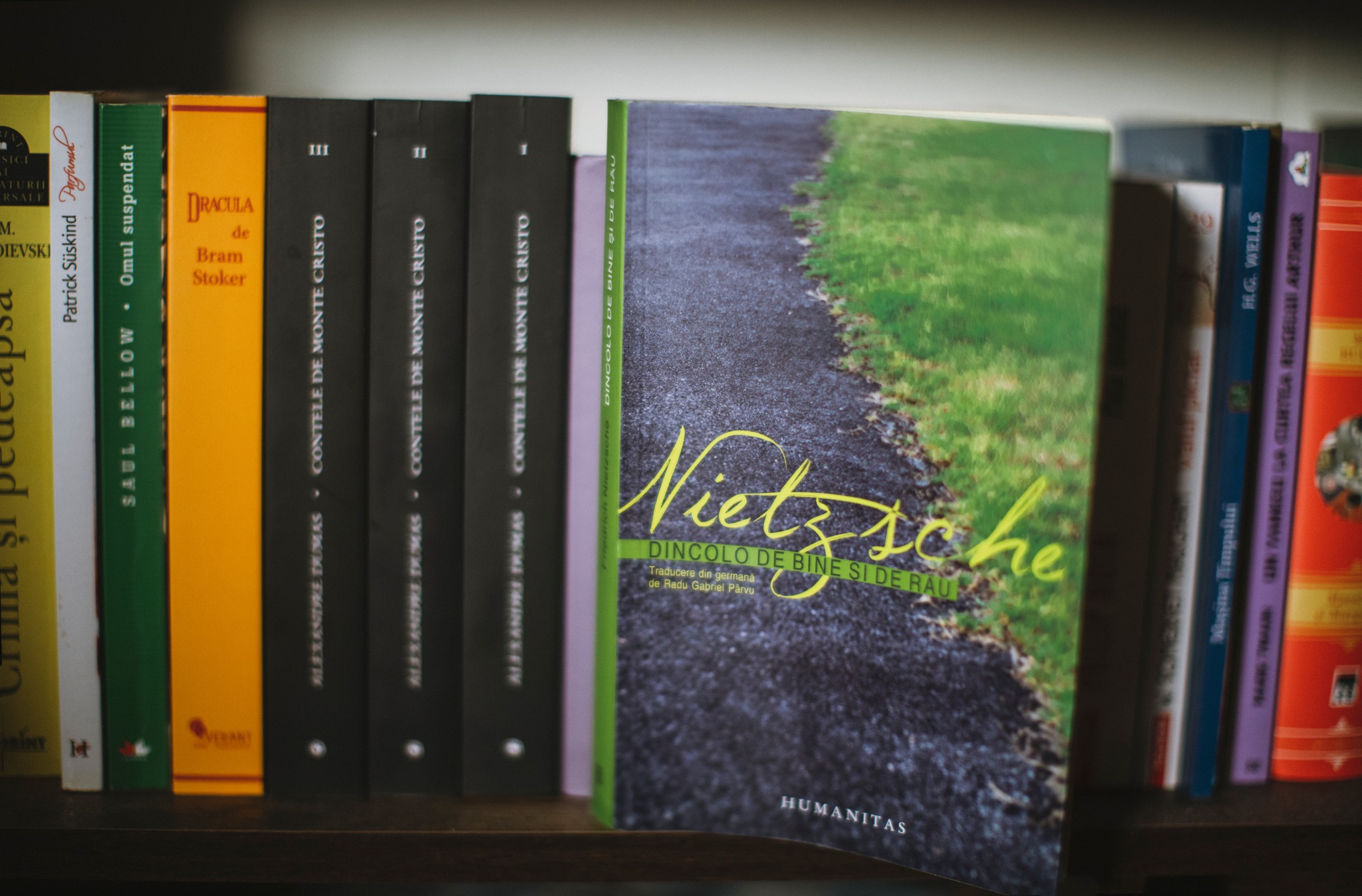
This is, I believe, the most difficult book I have read by Nietzsche. Some consider it his masterpiece. Whether it is or not, is irrelevant.
I continue Nietzsche’s work with the next book on my shelf, Beyond Good and Evil: Prologue to a Philosophy of the Future. The title is deliberately provocative. When we consider that so much of philosophy, theology, politics, sociology, and psychology is concerned with the subject and nature of good and evil, to dismiss it all at once with this “beyond” must have seemed a defiant gesture of shocking proportions. It is as if Nietzsche were saying that we have all been asking the wrong questions up to now. Finally, “beyond” and “future” introduce an element of history into subjects that the reader may not be accustomed to, or willing to, think about in historical terms.
Two Types of Morality
This book is often considered one of Nietzsche’s greatest and most accessible works (although I would not necessarily agree with this statement), offering a detached exposition of his major themes. From Brian Leiter’s point of view, going “beyond good and evil” involves abandoning the characteristics of slave morality and adopting those of master morality. The book presents itself as a “prologue to a philosophy of the future,” aiming both at the end of metaphysics and the beginning of a philosophy of the future. It is a critique of modernity, including modern science, arts, and politics, with the aim of initiating a reevaluation and reversal of eternal values in order to overcome the mediocrity and devaluation of humanity.
Two Philosophical Idiosyncrasies
Stuart Dalton notes that criticism of metaphysical thinking permeates all of Nietzsche’s texts, but Beyond Good and Evil offers unique dimensions to this problem. Drawing inspiration from The Twilight of the Idols, Dalton explains that metaphysical thinking arises from two philosophical idiosyncrasies: the belief that being is more real than becoming, thus requiring the postulation of “another world” beyond experience, and the conviction that the highest values (such as the unconditional, the good, truth, perfection) must have a pure, untainted origin (causa sui). This insistence on a pure origin comes from a desire to show reverence, assuming that what is “higher” cannot come from what is “lower.”
A unique aspect of Nietzsche’s critique in this book is his further investigation of the second idiosyncrasy of philosophy: the fundamental belief of metaphysicians is the belief in opposing values (see section §2). Nietzsche’s doubts about these opposing pairs call into question not only metaphysical thinking itself, but also the possibility of overcoming it. Any attempt to go beyond it risks creating new oppositions (e.g., metaphysics/anti-metaphysics), thus rewriting metaphysics in a new form (see section §20). This fact highlights the difficulty of ending metaphysics without reactivating it.
A Philosophy of the Future
Regarding the beginning of the philosophy of the future, Beyond Good and Evil explicitly bears the subtitle “prologue to a philosophy of the future” and addresses the issue of how such a project can be started without predetermining it. Nietzsche’s emphasis on “becoming” and “change” makes the future essential, for the will to power is oriented toward the future and presupposes self-transcendence through the creation of new ideals. Dalton emphasizes that, for Nietzsche, anyone who achieves their ideal transcends it eo ipso, and that there is melancholy in every ending: “Whoever achieves their ideal transcends it precisely by doing so” (p. 85).
Nietzsche suggests that a beginning is only possible by acknowledging that there is no absolute and determined beginning for a philosophy that cannot be prescribed. Instead, the beginning can be written by describing the character of the free spirit.
Dalton concludes that Nietzsche’s response to the possibility of beginning also implies a response to the end. Just as the free spirit simultaneously affirms and denies, so too can the opposing pairs essential to metaphysics only be denied to the extent that they are also affirmed.
End of Metaphysics
The end of metaphysics, like the beginning of a new philosophy, must occupy a space between the opposing pairs, rather than beyond them. This strange space offers the perspective from which both the end of the old and the beginning of the new can be written. This intermediate perspective is also reflected in Nietzsche’s discussion of the “will to truth,” which is not pure, but could be based on a “will to ignorance” (see section §24) or on less admirable motives (see section §5).
A Summary of the book
Nietzsche, a great wordsmith, suggests that all dogmatic philosophers were bad with women, if we consider the analogy of truth being a woman. Nietzsche personifies truth as a woman to emphasize that truth is seductive, elusive, and not something that can be possessed by force or domination. This contrasts with the traditional, dogmatic view of truth as something fixed, eternal, and objectively knowable, something a philosopher can seize through rational or metaphysical certainty.
By making truth a woman, Nietzsche hints that truth must be wooed, approached with artistry, sensitivity, and play, not with brute intellectual seriousness or rigid systems.
Chapter 1, on the prejudices of philosophers:
Nietzsche is critical of traditional philosophy. He argues that most philosophers are not objective seekers of truth, but are driven by hidden psychological needs and instincts. They fail to see that their philosophy is a confession of themselves, and their system of thought is built around this confession, which actually masks their own prejudices. It is like building a system from the bottom up, representing your own bias or prejudice, and then justifying it by writing thousands of pages about it (or them).
Chapter 2, The Free Spirit:
Nietzsche could be seen as a whiny kid if he didn’t have some ideas up his sleeve. He doesn’t just criticize certain aspects of human existence, but also suggests something new. To a large extent, it can be said that he had two major grievances: one with Judeo-Christian doctrine and the other with philosophy (and certain philosophers).
But for each of them he has a suggestion: for the first, after declaring the death of God, he proposes the superman, who is an ideal or a metaphor for the creation and introduction of new values; for the second, free spirits, or the philosophers of the future. Free spirits are “commanders and lawmakers” who create values through self-transcendence and lucid cruelty in the pursuit of knowledge, with the goal of the general development of humanity.
Chapter 3, Religious Nature:
Nietzsche describes Christianity as a slave revolt against the free spirit of Antiquity, marking a reversal of values through self-sacrifice and asceticism. These religious traits reflect, in his view, a passive nihilism and a denial of the will to live.
Chapter 4, aphorisms and interludes:
This part represents a stylistic change, moving from relatively continuous and sustained prose to aphorisms, which is not new for the mustachioed gentleman. Probably the best known of Nietzsche’s aphorisms is §146: “Whoever fights monsters should see to it that in the process he does not become a monster. And when you look long into an abyss, the abyss also looks into you.”
Chapter 5, on the natural history of morality:
The title suggests that Nietzsche will investigate morality from the point of view of its development over time and perhaps even its evolution in a more specific, namely biological, sense. And if it develops, it cannot be universal.
Chapter 6, We Scholars:
This part serves as a critical examination of the declining state of philosophy and the prevailing intellectual climate during Nietzsche’s time. He criticizes the harmful change in the hierarchical order between science and philosophy, arguing that science, “having separated itself most successfully from theology” (p. 130), now boldly attempts to dictate to philosophy. Nietzsche sees the scientist as a philosophus laborans, characterized by petty envy and an instinct for mediocrity; he describes him as a tool, rather than an end in himself, who organizes existing values but lacks the capacity to truly create philosophy. The scientist is “a human type lacking in nobility” (p. 133).
Chapter 7, Our Virtues:
The chapter begins by interpreting “ours” as meaning those of free spirits. But, because it opens with a question mark, it is not surprising that the section soon turns to the virtues (and vices) of modern European culture in general. But what does VIRTUES (Tugenden) mean? This is a term from moral philosophy. A virtue is a disposition we have, something we do frequently and well, to the extent that it is considered to lead us to be good people (e.g., charity). Thus, vice is the opposite: anything bad that we do frequently or compulsively (e.g., laziness).
Chapter 8, Peoples and Homelands:
This part deals with the variety and differences between peoples and homelands. Another aspect is that Nietzsche is, or wants to be, a European, a good European. This chapter attempts to link two concepts that seem quite different: art, especially music, on the one hand, and politics on the other. Nietzsche uses an analysis of music both in its own terms and, above all, to clarify his thoughts on the present and political future of Europe.
Chapter 9, What Does Aristocratic Mean?:
This is the last chapter (though not the end of the book) and looks at the question of aristocracy from at least two angles: first, historically, in terms of the origins and development of aristocratic societies; second, in terms of nobility as it is or is not encountered today, and especially in philosophy. Here we find some of Nietzsche’s clearest statements about the nature of plebeian morality and what is noble. Nietzsche’s ideal noble (or aristocratic) type contrasts sharply with slave morality and herd instincts.
Nach-Gesang
The poem with which Nietzsche ends his book should be seen as its climax, as Nietzsche’s most important attempt to push forward his writing project. As he notes in The Birth of Tragedy, that early book should not have been written as it was, but should have been sung. The German term NACH-GESANG is a literal translation of the Greek “epode.”
But Nietzsche does not follow the characteristic two-line structure and rhythm of a classical epode; he is more concerned with it as the last and completing part of an ode. We can say that this poem expresses Nietzsche’s vision of the free spirit: cheerful, solitary, and strong enough to dance with chaos and uncertainty. The poem marks the end of the book, but also the beginning of a “philosophy of the future,” more precisely one that must be lived, not just thought.
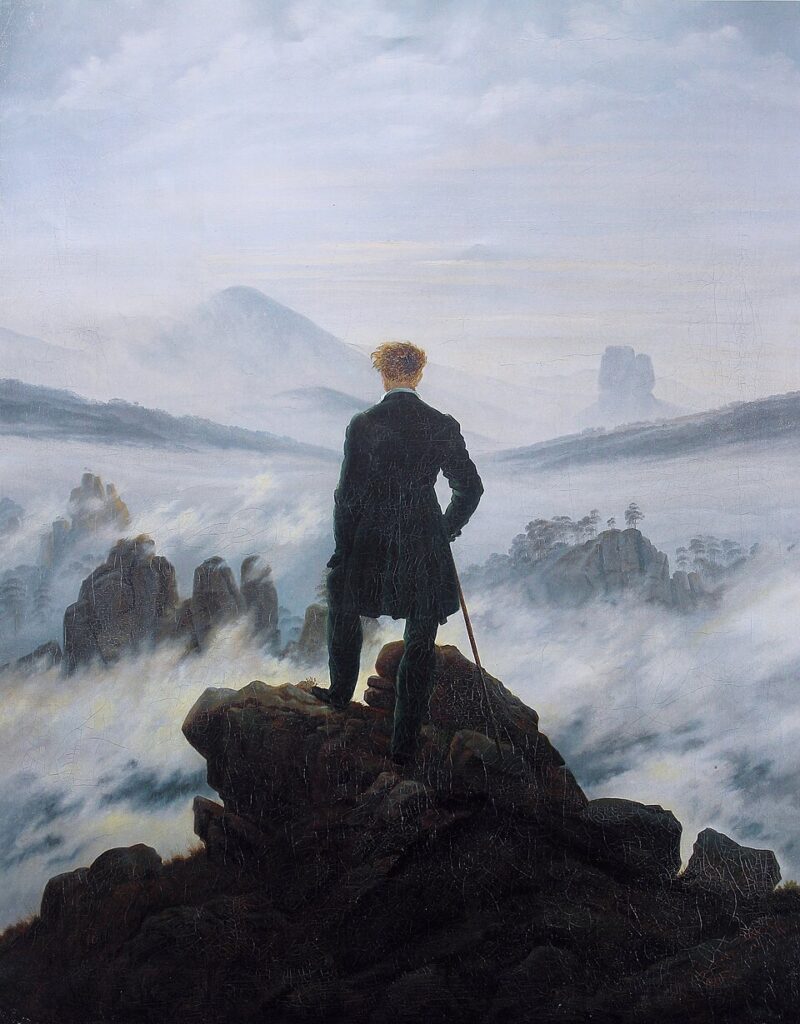
A section from the last chapter, namely §278, has remained in my heart. It is a parable. The parable of the traveler. A traveler returns unsatisfied, “with an unreadable look” (p. 232) from the depths. We want to offer him help and hospitality. But this proposal is rejected as a kind of intrusion, along with questions such as Who are you? What have you done? The traveller replies with: “Another mask! The second mask!…” (p. 233). What does this mask mean? It is either a shield of defense against such external intrusion or an expression of a tireless willingness to penetrate other depths. Could this traveler be Nietzsche’s free spirit?

1 thought on “Beyond Good and Evil: Nietzsche`s call to master morality”