“Power is not a means; it is an end. One does not establish a dictatorship in order to safeguard a revolution; one makes the revolution in order to establish the dictatorship […] The object of power is power.”
A very brief summary
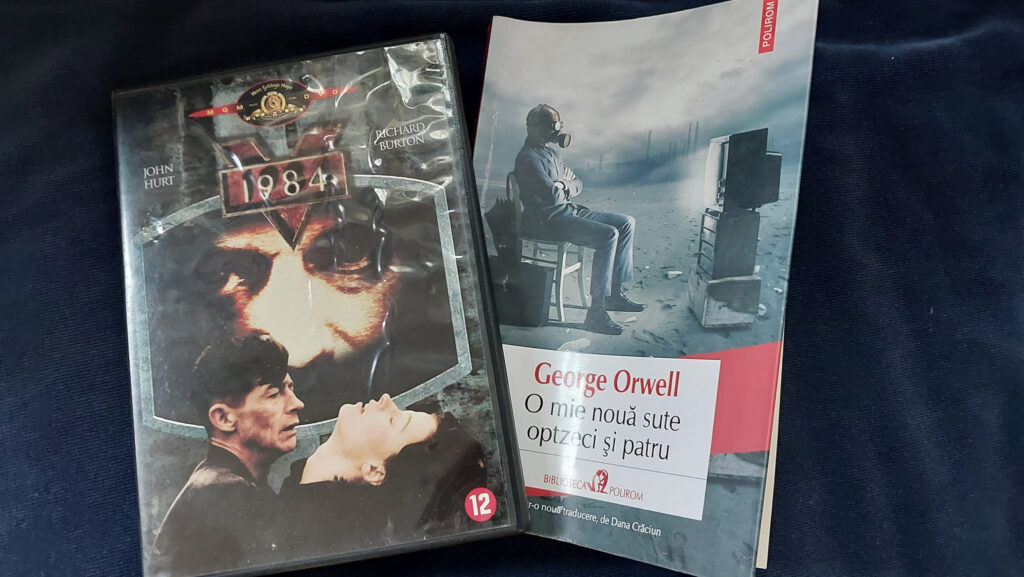
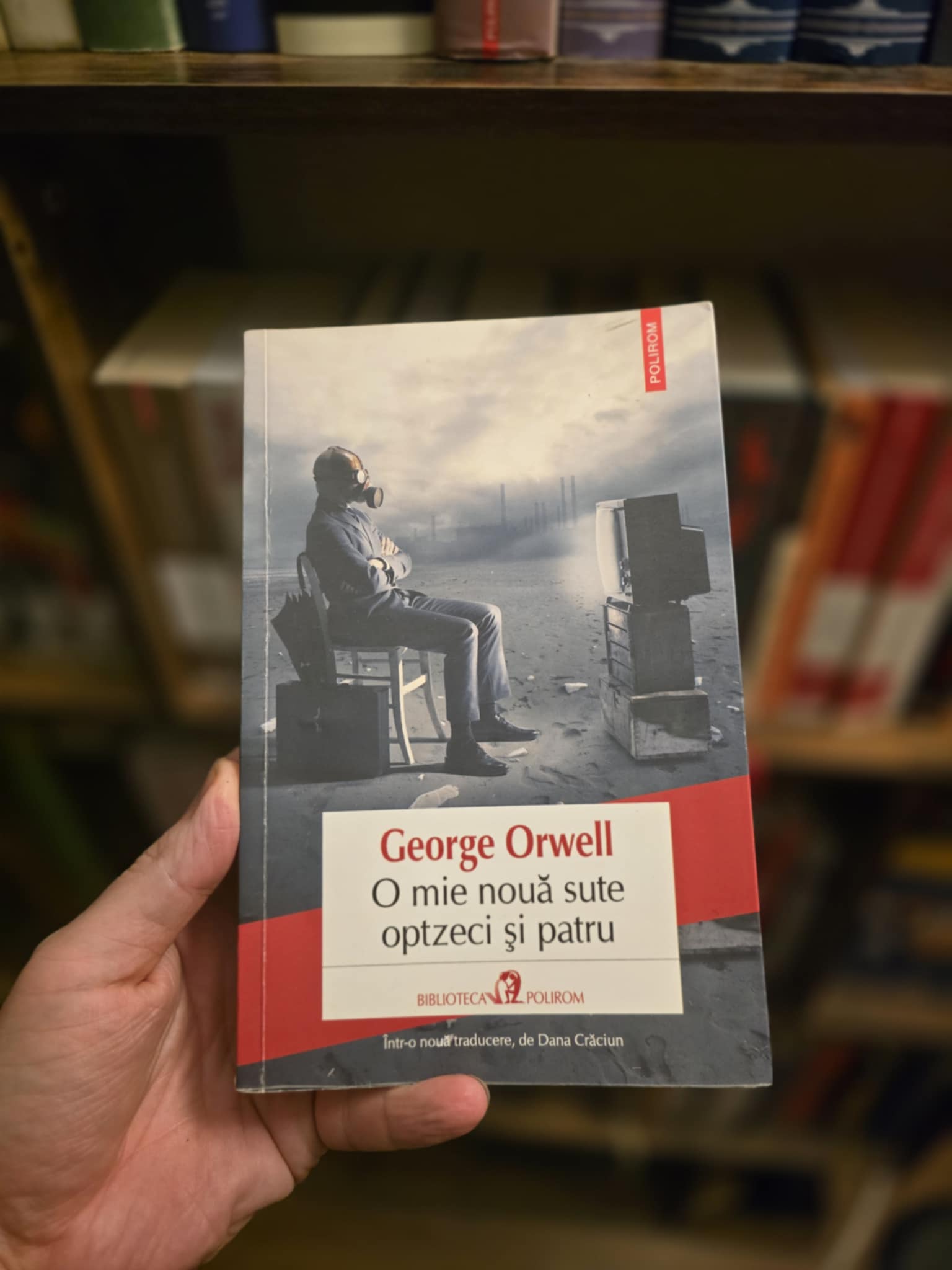
Orwell`s book depicts a future dominated by a totalitarian regime led by the omnipresent Big Brother. Society is tightly controlled through constant surveillance, propaganda, and manipulation of truth. The Party enforces absolute loyalty, rewriting history and even altering language through Newspeak to limit independent thought. The protagonist, Winston Smith, works at the Ministry of Truth, where he alters historical records to fit the Party’s narrative.
Despite the oppressive environment, he begins to question authority and seeks truth and freedom, secretly rebelling through a forbidden love affair with Julia. Ultimately, Winston is captured, tortured, and forced into complete submission, illustrating the terrifying power of authoritarian control and the obliteration of individuality, memory, and personal freedom.
Thoughts on the Book
In a world where life is lived in a continuous present, where history is perpetually rewritten, paintings repainted, streets and statues renamed, where nonexistent people are brought to life and the living are cast into oblivion or re-educated – one cannot help but wonder what human nature still means.
Of course, the Party can easily answer that, because the Party creates human nature. “We do not merely destroy our enemies; we change them.” And the Party is always right.
The social structure in 1984 does not differ much from societies that have existed throughout history, in the sense that there are also three classes here (under the names of the Inner Party, the Outer Party, and the proles), except that those in power have an agenda somewhat more… inhuman, though, unlike the communists, fascists, and Nazis, they lack hypocrisy.
Their goal is power itself: power for the sake of power.
Their power is so great that they can even alter the laws of physics and mathematics.
They are always right: “And if all others accepted the lie which the Party imposed, if all records told the same tale, then the lie passed into history and became truth.”
The Changing of Soul Bussiness
A fundamental aspect that distinguishes them from the inquisitors of the Middle Ages and from the totalitarian regimes of the twentieth century lies in the fact that they did not concern themselves with creating martyrs.
The heretics who burned at the stake gained all the glory, while the inquisitors took all the shame.
The Nazi and communist regimes humiliated and destroyed man through fabricated confessions; yet, after years, when the truth emerged, their victims became martyrs too.
The Party is in the changing of the soul-bussiness. Re-education cannot work otherwise.
Man is not merely forced to say that two plus two make five; he knows it to be so.
Man’s freedom is suppressed: “Freedom is the freedom to say that two plus two make four.”
The sexual instinct is repressed and orgasm abolished.
A new language is created — one that limits man’s ability to think.
It is a world that produces robots and cockroaches.
All that matters is loyalty to the Party and unwavering love for Big Brother.
It must be said that a work of literature is not like the Bible; it does not begin with Genesis and end with Revelation.
You enter a universe that has already existed for some time — and that will continue to exist long after.
Even though 1984 ends the way it does, I like to believe there is a glimmer of hope, which we glimpse in the protagonist’s dialogue during his torture: that there is something the Party will never be able to conquer: the Spirit of Man.
The Dynamic Between Truth and Reality
In his re-education process, Winston is told that “reality exists in the human mind”. If O`Brien so wishes, he can levitate from the ground. The Party makes and establishes the laws of nature. This kind of reality manipulation happened also in Romanian communism. The people behind the curtain could lie about anything, and all this ocean of lies would form the reality that surrounded everybody. But the truth lies (if I can make the pawn) beyond the lies.
For understanding lying more, I invite you to check my review on Liiceanu`s book, On lying.
What gives ambition to those who make up the Party is the anthopocentric view they held. They believe there is nothing outside men, and that Earth is the centre of the universe. And what this Earth hosts is a plethora of ghosts. Winston, as he is told, is the last of men. His re-education changed his soul.
In the book Fenomenul Piteşti, Virgil Ierunca tells us the story of the unfortunates who went through hell in this prison between 1949 and 1952. They made a system where everybody was tortured and was torturing everybody. The victim became the executioner, and the executioner became the victim. People were beaten on a daily basis untill they no longer recognize themselves. They were made to renegate their own parent and God and confess to things they were not guilty for.
In O`Brien eyes this was a mistake. Because we know the truth about this victims. In the world of Orwell this cannot happen. No one is forced to lie to themselves or others. They are transformed entirely. Their soul is changed. They do not just believe that 2+2 equals 4; they KNOW it!
A System of Tyranny
The arrival of 1984 sparked renewed interest in Orwell’s novel and prompted many to interpret it in modern contexts, such as through technology or consumer culture. Abbott Gleason situates 1984 in the late 1940s, a time of political disillusionment and the Cold War’s beginning, arguing that the novel captures the essence of an age of totalitarianism.
The term “totalitarianism” emerged in the 1920s after the rise of Fascism in Italy, initially used positively by Fascist thinkers to describe the all-encompassing power of the state. By the 1930s, it came to describe new forms of regimes in the Soviet Union, Germany, and Italy, systems that used modern technology to control individuals completely. Thinkers like Bertrand Russell and later Orwell emphasized how technology enabled despotic control over every aspect of life, even personal relationships.
By the time Orwell wrote 1984, “totalitarianism” referred to societies ruled by dictators, supported by powerful elites, and maintained through terror, propaganda, and surveillance. During the Cold War, intellectuals like Hannah Arendt, Merle Fainsod, and Carl Friedrich with Zbigniew Brzezinski solidified the concept into a model describing totalitarian systems as defined by ideology, one-party rule, terroristic policing, control of communication and weapons, and a command economy.
From Stalinism to Revisionism
After Stalin’s death, however, the model began to lose credibility. Scholars in the 1960s and after argued that terror and isolation had lessened in the Soviet Union, and that Soviet society was more complex, with social groups, informal networks, and a degree of private life. Revisionist historians such as Sheila Fitzpatrick suggested that Stalin’s policies were shaped by social forces and even benefited certain groups, meaning Soviet society was not entirely passive. Yet critics warned that this approach risked downplaying the immense suffering of Stalin’s rule.
In contemporary debates, conservatives maintain that the Soviet Union remained a unique, ideologically driven threat, while others, like Jerry Hough, argue it should be analyzed like any authoritarian state. Despite the decline of the totalitarian model’s academic influence, Orwell and his contemporaries captured a real and novel historical phenomenon.
Even if fear of Orwell’s world has faded, his warning about the destruction of private life remains relevant and may resurface in future generations’ anxieties.
Final question
Although bleak, the novel raises questions about whether resistance is possible under total control. What does it mean to remain human or moral in an inhuman system? What do you think?
For a more detailed summary and analysis, I will write in the future a review comparing the book and the movie through differences and similarities. I do recommend the movie as well!