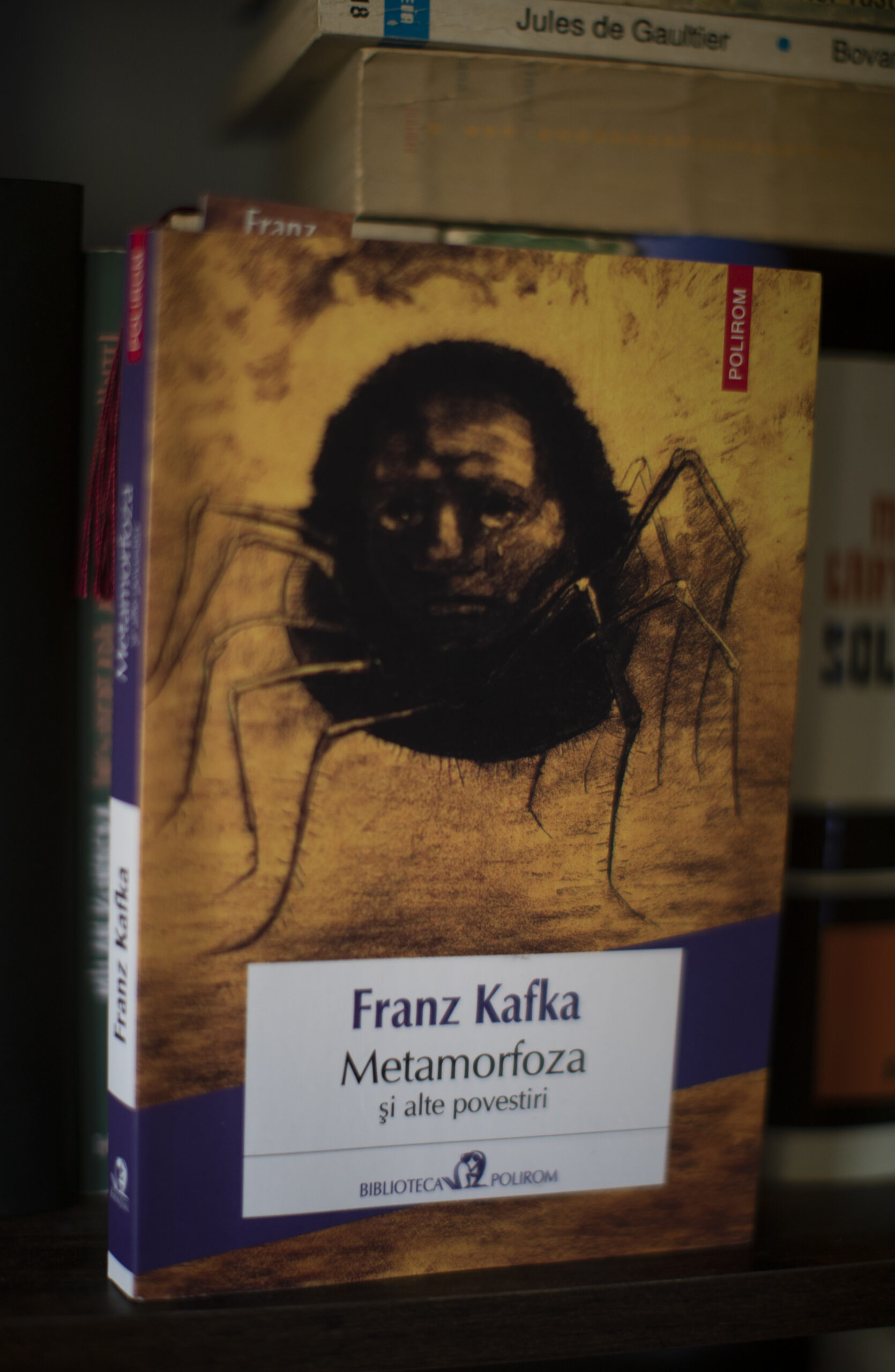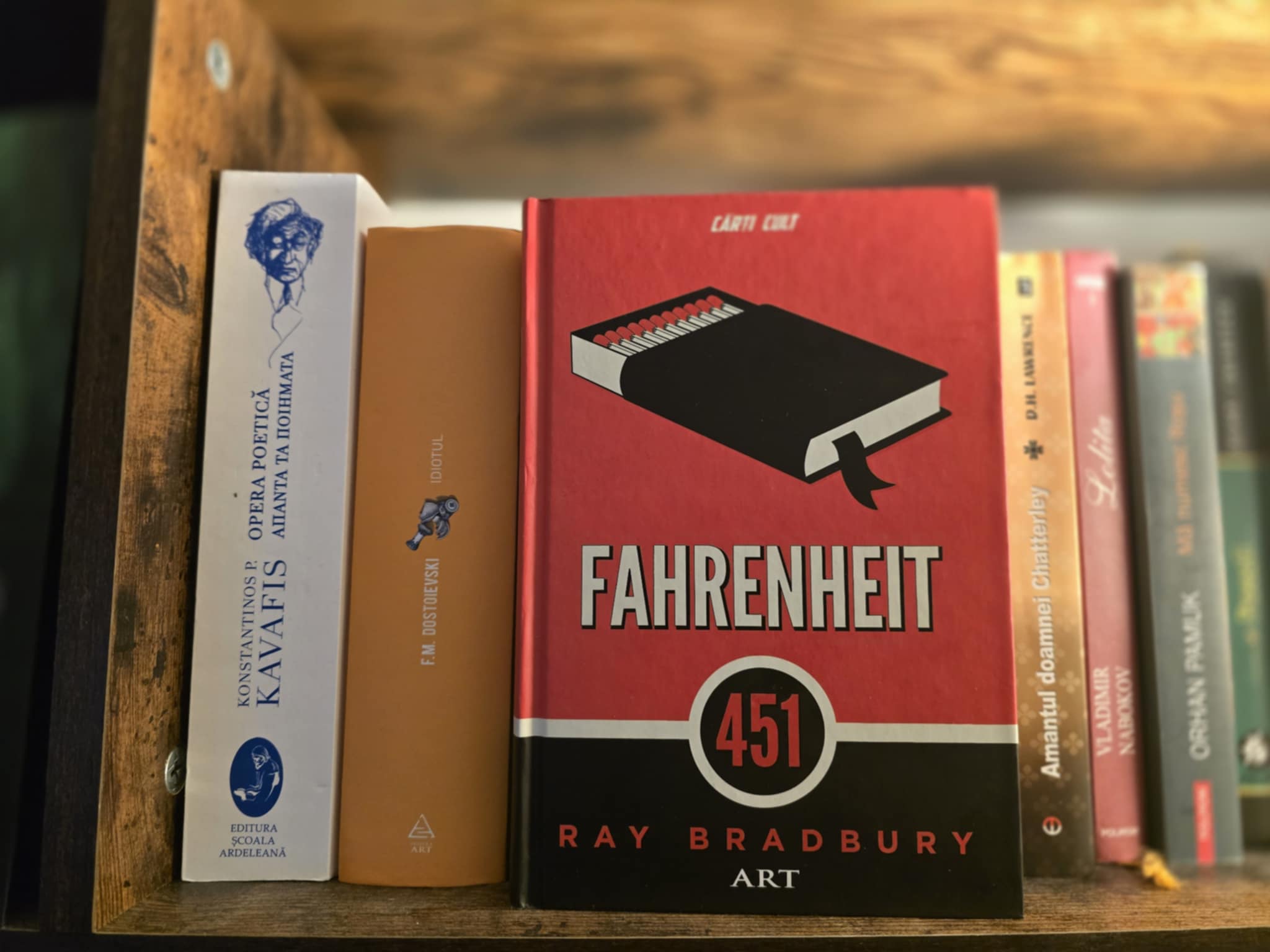
General Informations About the Book
Fahrenheit 451 is a dystopian novel published in 1953. The title refers to the temperature at which book-paper catches fire, and burns.
The book began as a story draft titled The Fireman in the early 1950s. This draft was initially written in a basement typing room at the UCLA Powell Library. Bradbury first recast the story as a 25,000-word novella titled Long After Midnight, which was eventually retitled back to The Fireman for its publication in Galaxy Science Fiction in February 1951. In 1953, Bradbury returned to the library and expanded the novella into a roughly 50,000-word novel. This final version was published by Ballantine Books on October 19, 1953.
The first edition originally included the novel alongside two short stories: And the Rock Cried Out and The Playground.
Bradbury began writing cautionary tales about censorship and book burning as a reaction to the Cold War climate of fear rising in America. He was also influenced by Arthur Koestler’s novel Darkness at Noon, which explored authoritarianism.
One specific inspiration for the character Guy Montag came from an incident in 1951 when a police officer stopped Bradbury while he was taking a late-night walk with a friend.
Ironically, the book itself suffered insidious and piecemeal censorship for years. Editors at Ballantine Books removed approximately 75 separate sections (including words like “hells” and “damns”) from school editions before the original text was fully restored in later printings.
The novel received several honors, including a $1,000 grant from the National Institute of Arts and Letters (1954), a Prometheus Award for best Hall of Fame Classic Fiction (1984), and a Retro-Hugo for best novel 50 years after its publication (2004).
A Brief Summary of the Book
Fahrenheit 451 is set in a dystopian future where firemen, such as the protagonist Guy Montag, do not extinguish fires but ignite them to incinerate books. In this society, the population is anesthetized by high-speed technology, massive wall-to-wall televisions, and pervasive advertising that discourages deep reflection. Montag’s wife, Mildred, exemplifies this vacuous existence, spending her days mesmerized by “the family” on her screens and nearly dying from a sleeping pill overdose.
Montag’s disillusionment begins after meeting Clarisse McClellan, a teenager whose curiosity and appreciation for nature spark his own awareness. His crisis of conscience intensifies after witnessing an elderly woman who chooses to burn alive with her library.
Seeking meaning, Montag begins stealing books and enlists the help of Faber, a retired professor, to understand the written word. Fire Chief Beatty, the novel’s antagonist, attempts to manipulate Montag, explaining that book burning arose not from government decree but from technology and minority pressure to avoid controversy and maintain a hollow happiness.
After Mildred betrays Montag by reporting his hidden library, Beatty forces him to burn his own house. In the ensuing confrontation, Montag kills Beatty and flees the city, narrowly escaping a lethal Mechanical Hound.
He eventually finds a community of intellectual exiles who preserve literature by memorizing entire books. As an atomic war suddenly vaporizes the city, Montag and the survivors resolve to return and rebuild a society based on the knowledge they carry, with Montag embodying parts of Ecclesiastes and Revelation. The story concludes with the hope of human redemption through history and memory.
The Meaning of the Three Parts of the Book
Part One: The Hearth and the Salamander
This chapter establishes the significance of the salamander as a central symbol of the firemen. Montag wears a salamander on his arm, has an orange salamander burning on his badge, and uses an igniter with a salamander etched on its silver disc. Additionally, the great fire engine used by the firemen is referred to as The Salamander. The “hearth” typically refers to the floor of a fireplace, often representing the home.
Part Two: The Sieve and the Sand
The meaning of this title is explicitly detailed through a childhood memory of Montag’s. As a child, a cousin challenged him to fill a sieve with sand for a dime; however, the faster he poured, the faster the sand sifted through, leaving the sieve empty.
In the novel’s present, Montag uses this as a metaphor for his attempt to memorize the Bible while riding the subway. He is bombarded by the vacuum-underground and the persistent, intrusive Denham’s Dentifrice advertisement. He reasons that if he reads fast enough, some of the “sand” might stay in the “sieve” before he has to hand the book over to Beatty.
Part Three: Burning Bright
The title is a direct reference to William Blake’s poem The Tyger, found in his collection Songs of Experience. Within the narrative, this part depicts the literal burning of Montag’s life and home. After being forced by Chief Beatty to use a flamethrower on his own house, Montag feels a sense of relief, concluding that fire was best for everything because it destroyed the senseless problem of his empty existence.
The title also reflects the end of Chief Beatty, who is turned into a shrieking blaze by Montag. Interestingly, Beatty’s final acts (reciting Shakespeare as he dies) suggest to some that he may have been a martyr who sought his own end as a silent protest against the censorship he enforced.
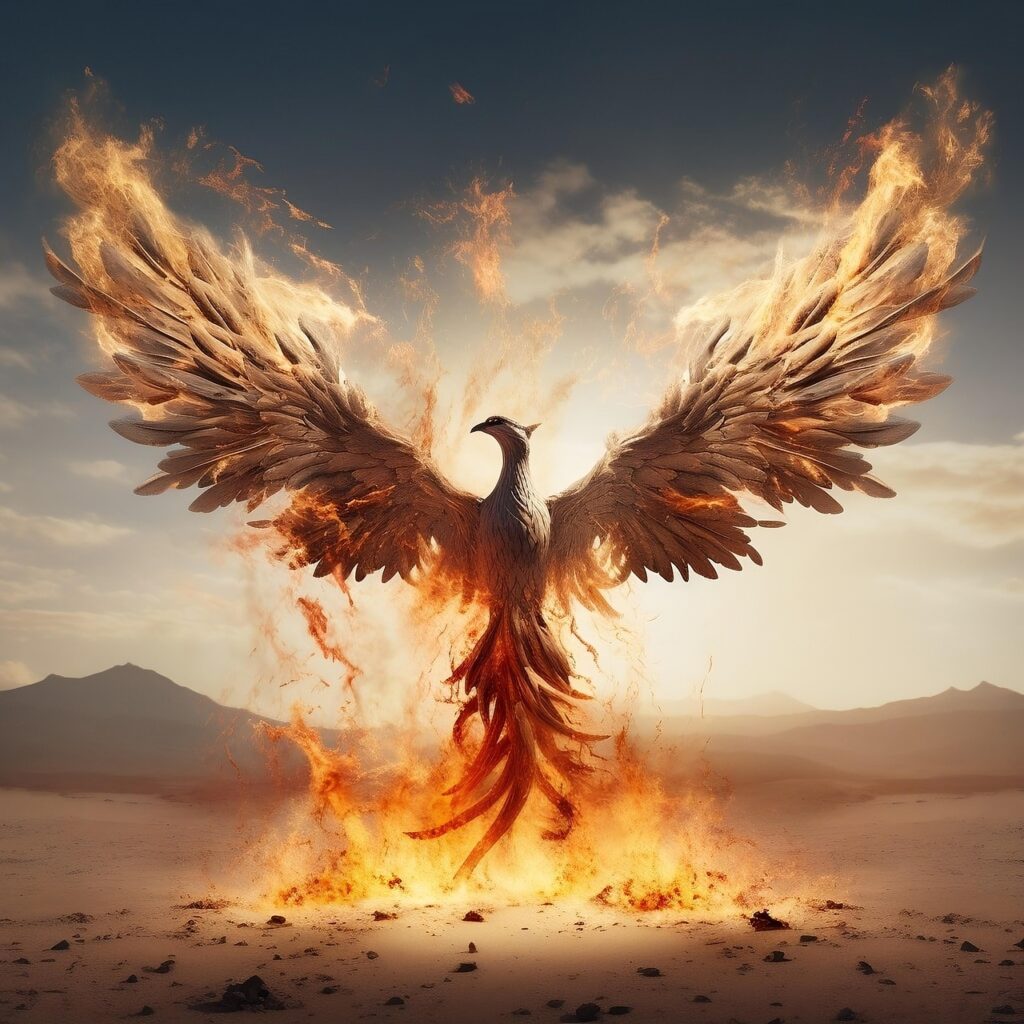
Metaphorically, the title aligns with the legend of the Phoenix, a bird that consumes itself in fire only to be born all over again from the ashes. This mirrors the fate of the city, which is vaporized by an atomic bomb, and the hope of the exiled intellectuals that society can be rebuilt from the wreckage.
Final Remarks
I had a neighbour who asked me what is reading good for if you will forget what you read. This is a frequently asked question. But I do not find it difficult to approach. It is just an ignorant question. You might as well ask what do you remember from the life you have lived up untill this point. And if you do not remember all, does it mean you did not live it? Every experience you have builds your identity. It is part of you. Same goes with education.
You do not have to remember what your parents told you when you were a child. It is part of you. “You see?” Granger turned to Montag. “Grandfather’s been dead for all these years, but if you lifted my skull, by God, in the convolutions of my brain you’d find the big ridges of his thumbprint” (p 174).
Memory is the ultimate weapon against censorship and a primary indicator of rediscovered humanity. In Montag’s thought-depleted society, characters like Mildred use technology and drugs to erase meaningful recollections, such as her suicide attempt. Montag’s awakening is signaled by his struggle to remember his past; he initially forgets meeting Mildred but recalls their Chicago origin only after the city’s destruction.
Memory ensures cultural survival through exiles who preserve banned literature by memorizing entire texts, becoming living books to safeguard history. This intellectual resilience allows the human spirit to rise from the ashes.