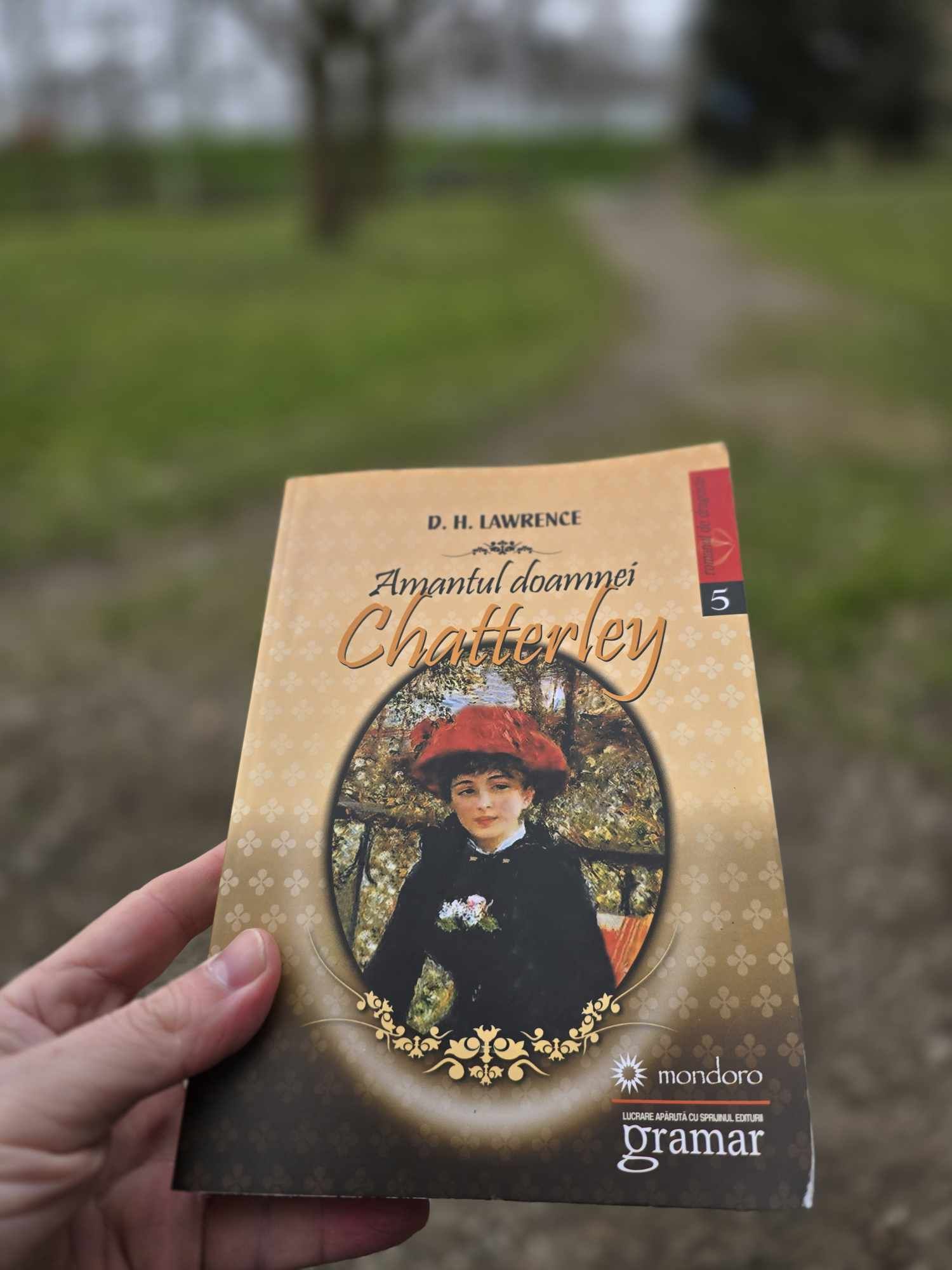
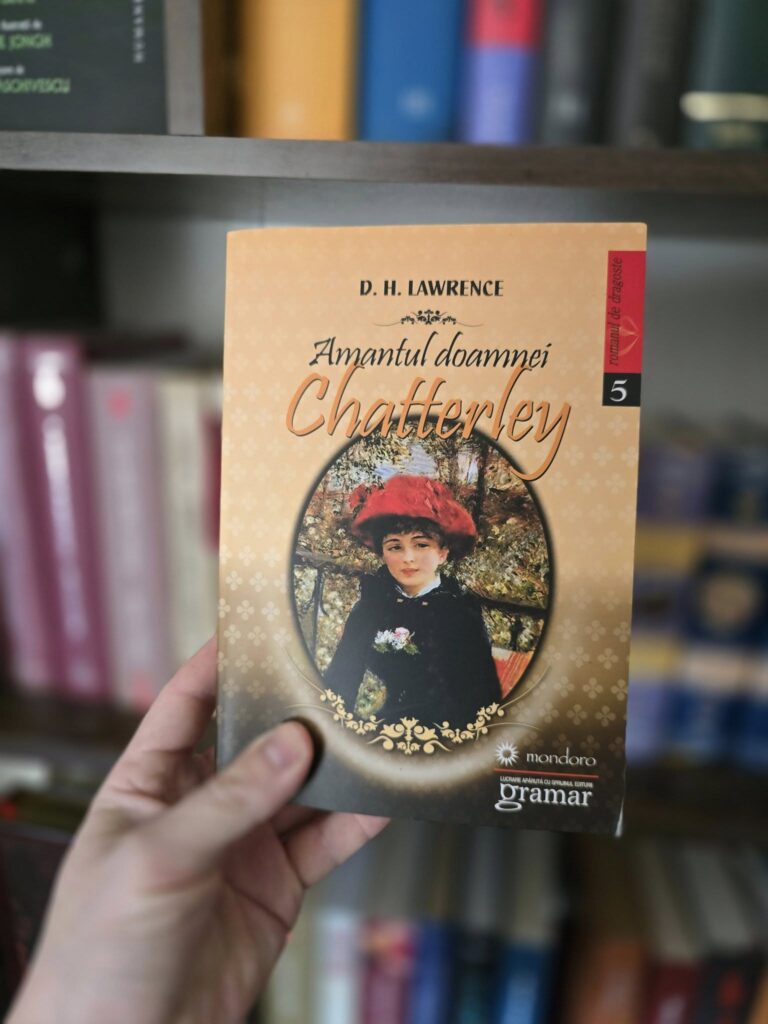
A Naughty Comparison
For those who’ve seen the 1993 film Indecent Proposal (itself based on a novel), you might notice a resemblance to this book, although with its own twists. In both cases, we have a married couple, a third person, and a proposal: in the film, it comes from the outside; in this novel, from within. Of course, the proposal has its nuances, but we can still call it equally “indecent.”
Sir Clifford, returned from the Great War, is paralyzed from the waist down, but wanting an heir, he suggests to his wife that she choose a lover (whose identity she should not reveal) to get her pregnant, and the whole affair to remain hush-hush so that the community would believe the child is theirs. A perfectly healthy love story!
Although banned in many countries for its explicit content and licentious language, I would argue this is neither the Marquis de Sade nor Melissa P., but rather a novel that explores love and sexuality in a somewhat restrained, semi-profane, and at times even humorous way. In this sense, I would place it somewhere between Lolita, rich in euphemisms and poetry, and The Erotic Diary of a 16-Year-Old, which bombards the reader with crude images and words.
The Exposition
The novel Lady Chatterley’s Lover, written by David Herbert Lawrence, begins in the wake of the First World War, in “essentially a tragic age” (p 13). The story centers on Constance (sometimes Connie) Chatterley, who married Sir Clifford Chatterley in 1917. Clifford returned six months later from Flanders permanently paralyzed from the hips down, knowing he could never have children. The couple settles at Wragby Hall, where their marriage becomes an intellectual partnership focused on Clifford’s ambition and writing.
The Conflict
Connie, however, is consumed by a “mad restlessness” (p 36) and a feeling of nothingness in their life of the mind. Her brief affair with the successful playwright Michaelis proves sexually disappointing, as she gains satisfaction only through her own efforts against his “hard, erect passivity” (p 50). Meanwhile, Clifford shifts his focus entirely to industry, gaining a new sense of power through the management of his coal pits, and relies on the nurse Mrs. Bolton for his daily care, developing a perverse intimacy that sidelines Connie:
“Clifford, however, inside himself, never quite forgave Connie for giving up her personal care of him to a strange hired woman. It killed, he said to himself, the real flower of the intimacy between him and her. But Connie didn’t mind that. The fine flower of their intimacy was to her rather like an orchid, a bulb stuck parasitic on her tree of life, and producing, to her eyes, a rather shabby flower” (p 129).
Connie finds profound fulfillment with Oliver Mellors, the gamekeeper. Drawn to his powerful, isolated vitality, their relationship begins in the woodsman’s hut. Mellors, an intelligent man who “died once or twice already” (p 329), believes the core of life is “fucking with a warm heart” (p 314). Constance becomes pregnant by him.
The End
The affair leads to scandal when Mellors’ estranged wife, Bertha, returns and spreads vicious rumors about his unusual sexual postures and names Connie as his paramour. Though Mellors begins divorce proceedings, Clifford, when confronted, is overcome by cold rage and spitefully refuses to divorce Connie, declaring he will wait for fifty years. Connie leaves Wragby, and she and Mellors agree to remain separated for approximately six months until his divorce is finalized, planning eventually to marry and start a new life together, possibly farming in British Columbia.
Differences in Viewing Love
Sir Clifford and Lady Chatterley have fundamentally different understandings of love.
Sir Clifford approaches love in intellectual and moral terms rather than through physical or emotional connection. He emphasizes duty and propriety, treating marriage as a social contract. After his paralysis, he becomes emotionally distant, seeing sexuality as nearly irrelevant, and focuses more on appearances and social respectability. Love is for him largely abstract and cerebral, rather than passionate or phisically.
Lady Chatterley, on the other hand, experiences love as a union of emotion, desire, and intellect. She feels unfulfilled in her marriage because Sir Clifford cannot satisfy her emotional and sexual needs. For her, real love requires intimacy, mutual pleasure, and a holistic connection between body and soul. Through her relationship with Mellors, she discovers passion and freedom, challenging societal norms and class boundaries.

An Indecent Proposal
Sir Clifford Chatterley suggests to his wife, Connie, that she should become pregnant by another man and raise the child as their own, allowing it to inherit the family estate and name.
The suggestion arose when Clifford and Connie were discussing the future of Wragby Hall and the importance of succession. Clifford, who was permanently paralyzed from the hips down and knew he could never have children, stated:
He told Connie, “It would almost be a good thing if you had a child by another man. If we brought it up at Wragby, it would belong to us and to the place” (p 71).
Parenthood as a Transaction
He later reiterated his view, stating he would not mind if she had a child, provided it doesn’t touch her love for him. He added, “it would be awfully nice to have a child running about the house, and feel one was building up a future for it. I should have something to strive for then, and I should know it was your child, shouldn’t I, dear? And it would seem just the same as my own” (p 170).
He believed that the “casual sex thing is nothing, compared to the long life lived together” (p 73) in their marriage. To him, a brief sexual encounter for the purpose of conception was merely something to “just subordinate the sex thing to the necessities of a long life? Just use it, since that’s what we’re driven to.” (p 73).
Clifford’s attitude changed drastically when Connie confessed that her actual lover and the father of her child was Mellors, the gamekeeper. At that point, his initial calculation was completely overwhelmed by cold rage and unspeakable, impotent hate, entirely directed against Mellors.
I think that a good analogy regarding Clifford’s suggestion is him being like a monarch, unable to produce an heir, ordering a surrogate to carry on the royal line, viewing the biological act as merely a necessary transaction rather than an emotional or moral issue that might challenge the integrity of his carefully constructed kingdom.
The 1959 Obscene Publications Act
The book was accused of obscenity when Penguin Books decided to publish it uncut in the UK. The trial and the 1959 Obscene Publications Act that made the trial possible, both reveal deep cultural changes in Britain regarding censorship, morality, and the role of literature in a modern, democratic society.
The novel had a difficult publishing history: written in 1928, privately printed in Italy, and long banned or suppressed in Britain because of its explicit sexual content.
For decades, British law followed the 1857 Obscene Publications Act and the “Hicklin test,” which judged a work obscene if any part of it could corrupt vulnerable minds. This standard ignored authorial intent or literary value, allowing even serious works to be censored. However, by the 1950s, social attitudes were changing, and a committee of writers and publishers (the Herbert Committee) pushed for reform. Their work led to the 1959 Obscene Publications Act, which for the first time allowed courts to consider a book’s overall effect and literary merit, and to admit expert witnesses in defense of a publication.
When Penguin Books announced their plan to publish Lady Chatterley’s Lover, the authorities brought the case to court to test the new law. The trial at the Old Bailey in 1960 became a cultural event. The prosecution, led by Mervyn Griffith-Jones, argued that the book was too indecent for general readers, famously asking the jury if it was “a book you would wish your wife or your servants to read.” The defense, represented by Gerald Gardiner and backed by Penguin founder Allen Lane, argued that Lawrence’s purpose was moral and artistic, not pornographic. They called thirty-five expert witnesses (writers, professors, and clergy) who testified that the novel, when read as a whole, was serious, honest, and profoundly moral.
A Victory for Literary Freedom
The defense’s arguments reflected ideas from New Criticism, a literary theory popular in mid-century universities that emphasized close reading and the unity of the text. The Act’s requirement to judge a book “as a whole” and to consider its dominant effect echoed New Critical principles: separating serious literature from mere obscenity depended on reading carefully, understanding structure, and respecting the inseparability of form and meaning.
The trial also had a strong social dimension. Penguin’s affordable paperback edition (priced at only 3s. 6d.) made literature accessible to ordinary readers, not just the elite. The defense turned this into an argument for cultural equality: everyone, regardless of class, should have the right to read and interpret literature.
On 2 November 1960, the jury declared Penguin NOT GUILTY. The verdict marked a turning point in British law and culture: it ended the old censorship regime, affirmed freedom of expression, and symbolized the democratization of literature.
The trial blurred the line between law and literary criticism; the courtroom became almost like a lecture hall, debating moral and artistic values. The case proved that literature could be judged by reasoned reading rather than prejudice, and that ordinary citizens could be trusted as critical readers.
The Lady Chatterley trial was not just about one novel’s sexual content, but was about modern society’s willingness to treat literature as art, to defend intellectual freedom, and to expand the right to read.
Final Thoughts
The novel also reminds me, again borrowing from cinema, of the movie Titanic, where class is a central theme. Lady Chatterley resembles Rose, who, though living among aristocrats, chooses to be with a man from the lower class (the bourgeois world) which, for someone like Sir Clifford, is so low that he tells his wife, “You’re one of those women who long for the mud” (p 445), implying moral decay.
Also, I will make a brief connection to Camus. Both The Stranger and Lady Chatterley`s Lover depict individuals confronting societal norms and expectations, though in different ways: absurdity vs. desire. Camus’ Meursault refuses to conform to social expectations, echoing how Lady Chatterley’s Lover challenges rigid moral and class boundaries. If you are interested, read my review on The Stranger.
If you enjoy love stories, voilà: here is a book of nearly 500 pages. Yet, it’s another example of how literature seems pathologically drawn to love stories that either end in separation or begin with a couple only to dissolve into loss and reconnection through another relationship. Most love stories in literature are about suffering and loss. But voilà, if you’d like to read it, buy the book!