The Escaped Cock
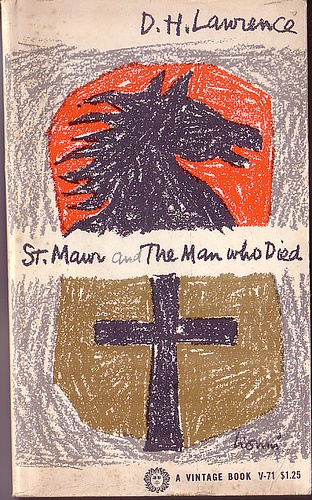
The man who died is a short novel by D.H. Lawrence which imagines a fictionalized Jesus.
In 1927, Lawrence traveled through ancient Etruscan sites following a period of extreme illness in Mexico and Florence that brought him very close to death. These experiences led him to feel that he had personally undergone a physical and spiritual resurrection.
On Easter morning in 1927, while in Volterra, Lawrence and his friend Earl H. Brewster saw a shop window display of a “toy white rooster escaping from an egg”. Brewster jokingly suggested the title “The Escaped Cock, a story of the Resurrection,” a suggestion Lawrence later adopted for the story’s first part.
The man’s slow painful return to life in the story is a transcript of Lawrence’s own feelings after his brush with death. Lawrence’s intent was to explore a resurrection in the flesh, not merely in the spirit.
Lawrence argued that traditional views of the Christ-Child and Christ Crucified were untrue to inner experience. Instead, he proposed a vision of Jesus as a full man who rose to seek the tenderness of a woman and the blossoming of the twoness with her.
The story’s provocative nature led to significant controversy and abusive letters. It was first published in parts in 1928 and 1929, with a limited edition appearing shortly before Lawrence’s death. The edition titled The Man Who Died was published posthumously in 1931.
The Man Who Died
D. H. Lawrence’s The Man Who Died explores the physical and spiritual resurrection of a fictionalized Jesus who, upon waking in his tomb, initially resents the unspeakable pain of returning to consciousness.
This protagonist, who has outlived his mission, realizes that his former life was a biopolitical compulsion that sought to force life into ideal patterns, ultimately denying the flesh.
Shortly after his awakening, he encounters a peasant’s escaped gamecock, which serves as a vibrant, phallic symbol of the triumph of life and the glow of desire that the man currently lacks. Rejecting his past as a physician of the soul, he decides to wander the earth as a simple healer, seeking a state of absolute immanence where he is finally alone within his own skin.
In the second part, the man reaches the coast of Lebanon and meets a priestess of Isis who is waiting for a reborn man. Their relationship centers on a physical ritual of healing in which the priestess anoints his crucifixion scars with oil, replacing the ghost of death with fresh life.
Through this tenderness, the man experiences a second resurrection, one in the flesh, declaring, “I am risen!”. This union, which results in the conception of a child, represents the man’s final transition into a unitary living being no longer split by a transcendent mind.
The story concludes with the man escaping into the night by boat, feeling one with each other and embracing the phenomenal world with the realization that “tomorrow is another day”.
Cimatti, Foucault and the Panopticon
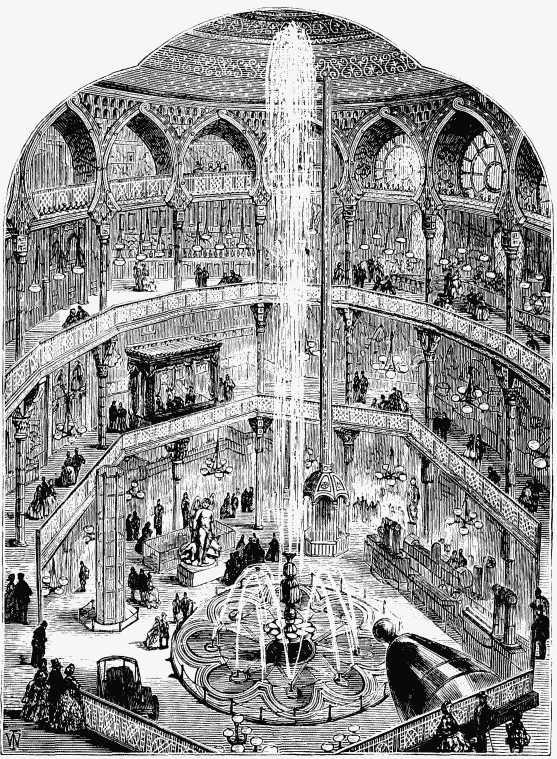
Felice Cimatti argues that the most pervasive biopolitical device is the self-conscious subject, which functions as its own internal Panopticon.
In this Foucauldian model, the subject monitors its own body, internalizing external political power to create a radical dualism where the mind acts as a “controller” over a “controlled” body. This split defines the biopolitical animal, a human whose living body is reduced to a technical tool serving the subject’s will.
Cimatti refutes this dualism by proposing a move toward absolute immanence, or the posthuman condition. This state is achieved when the internal hierarchy is deactivated, allowing the human to become a unitary living being once more, properly animal. In this condition, the “I” no longer monitors the flesh, and the gap between subjectivity and actual life disappears.
D. H. Lawrence’s resurrected Jesus serves as the primary illustration of this shift. In his life before the crucifixion, Jesus was a dualistic entity, a “physician of the soul” driven by a transcendent mission. Cimatti views this mission as a biopolitical compulsion that forced life into ideal patterns.
Upon his resurrection, however, the man realizes that the “teacher and the saviour are dead in me”. By outliving his mission and his transcendent mind, he ceases to be a biopolitical animal. He is reborn as a simple human who is “alone within his own skin,” discovering that the phenomenal world is more marvelous than salvation.
No longer driven by an internal observer or an external God, he can finally “believe in the world as it simply is”, experiencing a life of absolute immanence where the mind and body are no longer bifurcated.
Savior and Cock
Evelyn J. Hinz and John J. Teunissen’s 1976 article, Savior and Cock: Allusion and Icon in Lawrence’s
The Man Who Died, argues that the symbolism in The Man Who Died is deeply rooted in pre-Christian, pagan prototypes, specifically the Greek god Asclepius.
They suggest the protagonist’s identity as a healer carrying a cock alludes to Asclepius, the god of medicine, whose traditional thank-offering for recovery was a rooster. While Socrates ironically owed a cock to Asclepius as a tribute for being released from the illness of life, Lawrence’s protagonist restores the symbol’s original meaning by rejecting a mission of spiritual salvation for a vocation of physical healing.
The authors contend that Lawrence views both Christianity and Socratic rationalism as religions of the dead body that deny the flesh in favor of the spirit. The man’s rebirth is a transition from being a physician of the soul to a healer of men’s bodies, replacing compulsion with tenderness and compassion.
A central thesis of the article is the influence of a Vatican bronze icon (a composite of a phallus, a cock, and a man’s head) titled “The Saviour of the World”. This prototype provides an iconographic rationale that unifies the story’s two parts, linking the literal gamecock of Part I to the phallic/sun imagery and the resurrection in the flesh in Part II. The authors argue the work is not a new myth but a revitalization of ancient symbols preserved in the collective unconscious.
Final Thoughts
We can conclude that The Man Who Died represents, for Lawrence, a radical rejection of the dualism between spirit and body that dominates both traditional Christianity and Western rationalism. The resurrected Christ is no longer a savior driven by a transcendent mission, but a man who rediscovers immediate, bodily, and sensual existence. In Cimatti’s terms, he ceases to be a biopolitical animal controlled by an internal disciplinary self and becomes a unitary being, reconciled with his own animality and with the world as it simply is.
The symbolism of the cock and the references to Asclepius reinforce this transformation: the protagonist moves from saving souls to healing life itself, the living body. Lawrence thus opposes a religion of transcendence and sacrifice with a pagan form of bodily sacredness, in which rebirth does not mean the triumph of spirit over flesh, but the reintegration of man into the fullness of earthly life.