The Story
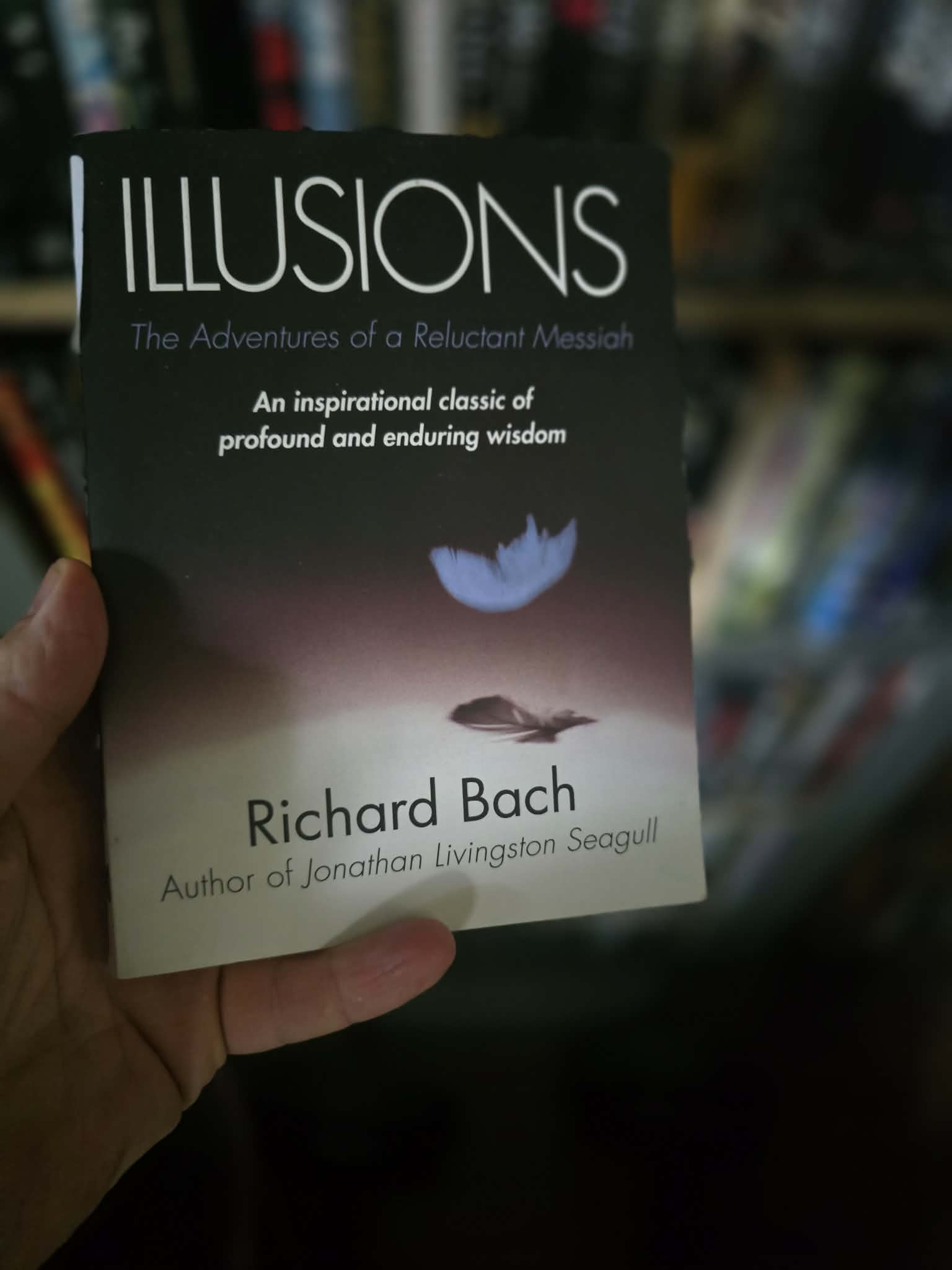
Barnstormer pilot Richard Bach meets Donald Shimoda, a fellow pilot flying an impossibly pristine gold-and-white Travel Air biplane. Richard soon discovers that Donald is actually a famous, retired Mechanic Messiah who recently quit his impossible task of saving a demanding crowd that wanted him to live their lives for them. Staying together to fly passengers across the American Midwest, Donald teaches Richard that the physical world is a mere illusion, comparable to a movie we choose to watch and direct for our own entertainment and learning.
Donald shares his suede-bound Messiah’s Handbook, a magic book without page numbers that always opens to the exact maxim the reader needs. Under Donald’s guidance, Richard begins to experiment with his own subconscious powers, like learning to vaporize clouds, walk on water, swim in the earth, and magnetize physical objects like a blue feather. Donald demonstrates incredible miracles, such as instantly healing a paralyzed man in Troy and walking through solid brick walls. He emphasizes that everyone is a son of God and is completely free to do whatever they want to do, explaining that we choose our own realities, tragedies, and limitations.
However, Donald’s uncompromising teachings on absolute personal freedom and his refusal to placate fearful crowds trigger growing hostility. During a controversial radio talk show, Donald angers listeners by declaring that good and evil are illusions. This culminates when an angry man shoots and kills Donald in a cow pasture. Devastated, Richard later meets Donald in a vivid dream. There, Richard repairs Donald’s plane with his mind, realizing that there is no real death and that space-time is just a playground. Donald urges Richard to write down his experiences, prompting Richard to begin writing this very book.
First Impressions
This book was recommended by a friend, and I decided to put John Milton on hold to see what was it all about.
Now, this book is a quick read, you can even read it in one day, which I did not because I am the busiest person in the world, but it is short and written in a quite simplistic way. Now, simplicity is not a bad thing, as a matter of fact it can be the best thing. Our teacher told us that beauty can reside in what is either small, old and/or simple. But it is not only about beauty when it comes to writing, but also what you are saying. so, most of the time if you want to transmit some deeper message it requires such type of writing. Now this friend mentioned to me Coelho, although I am not a big fan of him. I think he is a great personality but not a great author. If you want simplicity in literature I would recommend Hemingway.
But ok. I must say that this was a very frustrating book to read because it makes a big claim. And the claim is not backed up with arguments. But then again, it is not a philosophical essay. It is more of a spiritual book. And the claim is that everything is an illusion. Not only that, but the Messiah character says clearly that we are not walking bodies nor molecules. So, there are actually two claims here wrapped in one. It looks like it is arguing for immaterialism. A while ago I read and reviewed a book called “I am God” where the author argues for the immaterialism of existence. Everything we see and experience are ideas in the mind. This is a non-dual perspective. Is this what Bach is saying here? Is it Advaita Vedanta philosophy? Or is it LIKE Advaita Vedanta? So, it was frustrating because I could not see the direction of the author here.
But after finishing the book it was clear that the claim made is not a purely philosophical one which requires strict argumentation, but it is more of a spiritual/mystical one. Or even you can see the whole story as a metaphor for something. For what exactly? Well, at least two notions are evident on the surface. Freedom and acting. No wonder the Messiah is an aviator. The plane here itself is a metaphor for freedom.
But to be clearer I would post here a passage from the book:
“Do you think that maybe if you say impossible over and over again a thousand times that suddenly hard things will come easy for you?” (p 100)
So, if you justify your incapability of doing things you will always keep yourself in the corner. It is possible to do something if you have the right mentality. It is even clarified more after a few sentences by the use of the Messiah’s Handbook:
“Argue for your limitations and you get to keep them.”
Now, there is something else worth mentioning here. The Golden Rule: “treat others as you would want to be treated”. Messiah has a problem with this because it leads us imposing our own values and desires onto others, but you never know what others think or feel. So, he revises it: “do unto others as you truly feel like doing unto others”. This makes freedom an authentic desire at the basis of action.
Bach’s view stands in opposition to Kant’s categorical imperative, which does not make morality dependent on our desires but asks whether the principle behind our actions could be willed as a universal law.
Indian Philosophy?
The book does not explicitly label these concepts as Indian philosophy. However, the author, Richard, does intuitively link these ideas to Eastern spiritual traditions.
When he first wonders what it would be like to meet a master who has power over the illusions of the world, he imagines a “Siddhartha or a Jesus” coming into our modern time. Later, when asking Donald about the grand scale of his former messiahship, Richard asks if Donald had “the whole show, like you see in the movies from India” with crowds, incense, and golden platforms.
But yes, the material world does not exist as an independent, physical reality. Matter, bodies, space, and time are completely insubstantial projections of our own imagination.
Donald teaches that we are not physical beings, but rather “unkillable, indestructible ideas of the Is”, existing perfectly beyond physical constraints. The physical universe is just a temporary movie or exercise-book we voluntarily enter for entertainment and spiritual learning. It is an illusion because we can instantly transcend its rules (like walking through solid brick walls) once we realize that our identity is real, but the physical restrictions of the world are fake.
Last Impression
I had to ask myself: what is the message that Richard Bach is trying to convey with this short book? Surely, he does not prepare me for walking through walls or on water. That would be absurd. What then? What is he saying?
The physical world is a mere illusion, like a space-time movie we choose to experience for fun and learning. Within each of us lies the absolute power to control our own health, freedom, and happiness. Our only true obligation in any given lifetime is simply to be true to ourselves.